Days 68 and 69: A Wrinkle in Time.
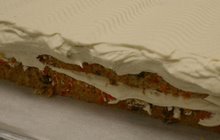
It’s been tricky finding words for this next cake. But I suppose that’s true of any cake whose execution requires the use of a pasta roller. The Chocolate Ribbon Cake, as it’s called, is a chocolate lover’s dream… layers of chocolate cake filled and iced with chocolate mousse, wrapped in a layer of chocolate plastique, and decorated on top with curly ribbons in the same medium. Cranking out cakes and mousses these days is pretty simple; literally cranking out paper thin sheets of chocolate is another matter.
Chocolate plastique is made by adding a small amount of corn syrup to melted chocolate. Once this re-hardens, you knead it until it is smooth and pliable; the texture reminds me of the probably toxic modeling clay that I used to play with more years ago than I care to count. Using it to sculpt things like baroque flowers is a treat we’re saving for down the road a bit. For the chocolate ribbon cake, the grandest assignment on the proverbial chalkboard was to make rectangles. Lots and lots of rectangles. The first of these, of course, was a very long rectangle, a band with which we covered the sides of the cake. Obviously you don’t want the people eating this cake to get such big globs of this chocolate material in their mouth that it would leave them singing Everything I See Looks Like a Ribbon Cake To Me, if you catch my drift. It’s a little like… well, modeling clay, as I said. To avoid just this predicament, we rolled the plastique to incredible thinness using the pasta roller. Now, I wasn’t there when the ingredients for our plastique were measured, but it seemed pretty straightforward. I don’t know what went wrong exactly, but my team’s came out dramatically different than everyone else’s. It was extremely melty, if that’s a word, and it had a peculiar interest in wrapping itself around the pasta machine’s rollers rather than gracefully passing through them. When chocolate plastique does this, all there is for it is a light dusting of cocoa powder, but if you can’t imagine how dangerous that is, go dip your finger into some cocoa powder and lick it off. Gingerly dusting our glob with two-molecule-thick layers of cocoa powder, we coaxed it through the rollers, gradually narrowing them, re-dusting at the first signs of trouble, until it was thin enough to be applied to the cake (not to mention palatable). We wrapped our band around the sides of the cake as smoothly as possible, sealing it at the seam.
The balance of rectangles were much smaller, about two inches by three. We made dozens of these after rolling out the remainder of our plastique. Then, as if we hadn’t teased it enough, we pleated up each small piece and laid it on top of the cake, overlapping each with the next. As unhinged as I had become, beset by roller-woes, I was forced to admit to myself after completing half the top that the cake was taking on a very elegant aspect. In quite a contrast to the buttercream and ganache we’ve been covering our cakes with so far, its plastique covering lent this cake a very fabric-like appearance. (Surely this is a hint of what’s to come when we undertake our segment on wedding cakes in the final quarter.) Continuing around the entire circumference in this manner, and then again in smaller circles, we carried on until the entire surface of the cake was safely tucked away. Some simple decorations on the top, including our introduction to gold paint, and the cake was ready for display in any bakery’s window.
I was pleased with the way my cake looked, and, clearly, excited about how it would taste. Later, however, an odd thing happened. As we traveled home, I gave the cake to a random woman who came upon my classmates and me on the subway. There can be only one of two explanations for this. Either I had reached the point where the Voice of Pastry is calling out to me less forcefully, or I had simply had too much sugar during class. I certainly hope that the latter is the case.
The former is too depressing.
Thursday, May 10, 2007


Thursday, May 3, 2007
Days 64, 65, 66, and 67: Melody. Rhythm. Harmony.
In a journal of superlatives such as I have created here, it is difficult to present an accurate account of this next confection. Rather than going on an on and saying things like: No, really, this one is my favorite, I will summarize in a word. Paris. It’s the Paris of desserts. It is refined and elegant, mysterious and a little proud, expensive, complicated, torrid and searingly beautiful. I’m sure there are many other desserts with the same name: Symphonie – a simple Google Image search confirms this suspicion. I defy any of them, however, to hold an audience quite as rapt as this one managed to. In a rare career crossover attempt, I shall indulge myself briefly in the obviously begged comparison of this dessert to a symphony. (For you Classical music geeks, think of it as inside-out R. Strauss.)
The basis of any solid symphony is melody (let’s not get into a musicological debate about this; just roll with me). It’s the tune people hum after the show; a mental imprint of the experience. The number this dessert sang was Chocolate and Hazelnut, a club favorite for centuries. The dress it wore was a showstopper too – a rich satin robe by Ganache, with gold accents. Everyone who was there whistled long after the show.
You have to have rhythm if you want any kind of texture. This cake was almost Bartók. From the snap of the chocolate on the bottom to the crunch of the ground hazelnuts caught up in each chocolate cake layer to the praline buttercream, smooth as silk between each one, the full spectrum of texture was available to anyone who had a bite.
Finally, the coalescence of all the elements: the harmony. Here, no dynamic was too loud, no phrasing too blatant. All the elements of this marvelous work converged in Mozartean balance, each note exactly where fate would have it put, each voice exactly where it belonged in the context of those surrounding it. It was so perfect as to seem plucked from the air.
Alright, so what the heck was it? It took us a number of days, with multiple sets of pans, mixers, freezers, and decorating supplies, to create all the elements of the symphonie. We began by painting a rectangular layer of hazelnut sponge (like a génoise) with some chocolate. Once that had set, we turned it over, making the very bottom of the cake a sheen of slightly snappy chocolate. We then moistened the cake layer with kirsch-flavored syrup, and iced it with a layer of whipped ganache. Not ordinary ganache (half-chocolate-half-cream), though. Here, we used ganache riche. (Five points to the person who can guess what riche means in French.) This ganache has a bit more chocolate in it and so imparts a deeper chocolate note. When that layer was down, we iced it again, only this time with praline buttercream, which is essentially buttercream with praline paste whipped in. Think of praline paste as peanut butter, only slightly more liquid, and made from hazelnuts. (I know; it’s pretty awesome.) Usually, in a buttercream, we would whip egg whites with sugar and eventually add (lots of) butter. For this one, though, we whipped egg yolks with sugar, and added (still lots of) butter. It made it quite as rich as you would imagine it might. Atop this second layer of filling, we placed a layer of almond cake called biscuit joconde (bis-KWEE zho-COHND). My sources tell me that “jocund,” as it would be in English, means “characterized by joyful exuberance.” I see their point. This layer was treated the same way as the lower one, with syrup, whipped rich ganache, and praline buttercream. We placed a third layer, this time hazelnut again, on top, and moistened it with syrup. At this point, we did not continue as before with a dual layer of icings, but rather with whipped ganache only, which we spread level and to exacting smoothness. The cake was then allowed to refrigerate and firm up before the final steps. The finishing touches involved pouring a sleek liquid coat of (ordinary) ganache over the top, strategically dropping some gold leaf at the corners, and, in what we were informed was the traditional way, inscribing the name of the dessert across its front, in chocolate ink from our favorite pen, the cornet. So to tally, for those including myself who have lost count, the layers from the bottom up go something like this: chocolate, hazelnut cake, whipped rich ganache, praline buttercream, biscuit joconde, whipped rich ganache, praline buttercream, hazelnut cake, whipped rich ganache, poured ganache. (Not counting syrup and decorations.)
It sounds like too much, I realize this, but once again you must trust me; it’s not. The finished cake is perhaps three inches high, each layer being incredibly thin. All these rich ingredients come together in the right proportions, and form a dessert that is perfectly balanced in weight, sweetness, flavor, and texture. One friend who picked up a piece while in her car called me from her cell phone before having bothered to swallow (I was praying she was at a stoplight), and stated that it was hands down the best cake she’d ever had. I have to say, I was in agreement. This symphonie truly lives up to its name, as so few desserts bearing such a name ever could. And after eating it, not because it was heavy but because it was so immensely satisfying, you remember another integral part of any line of music: the space in which you can luxuriate for a fleet moment, before the effects of what you’ve just experienced can be carried away by something new.
Rest.
In a journal of superlatives such as I have created here, it is difficult to present an accurate account of this next confection. Rather than going on an on and saying things like: No, really, this one is my favorite, I will summarize in a word. Paris. It’s the Paris of desserts. It is refined and elegant, mysterious and a little proud, expensive, complicated, torrid and searingly beautiful. I’m sure there are many other desserts with the same name: Symphonie – a simple Google Image search confirms this suspicion. I defy any of them, however, to hold an audience quite as rapt as this one managed to. In a rare career crossover attempt, I shall indulge myself briefly in the obviously begged comparison of this dessert to a symphony. (For you Classical music geeks, think of it as inside-out R. Strauss.)
The basis of any solid symphony is melody (let’s not get into a musicological debate about this; just roll with me). It’s the tune people hum after the show; a mental imprint of the experience. The number this dessert sang was Chocolate and Hazelnut, a club favorite for centuries. The dress it wore was a showstopper too – a rich satin robe by Ganache, with gold accents. Everyone who was there whistled long after the show.
You have to have rhythm if you want any kind of texture. This cake was almost Bartók. From the snap of the chocolate on the bottom to the crunch of the ground hazelnuts caught up in each chocolate cake layer to the praline buttercream, smooth as silk between each one, the full spectrum of texture was available to anyone who had a bite.
Finally, the coalescence of all the elements: the harmony. Here, no dynamic was too loud, no phrasing too blatant. All the elements of this marvelous work converged in Mozartean balance, each note exactly where fate would have it put, each voice exactly where it belonged in the context of those surrounding it. It was so perfect as to seem plucked from the air.
Alright, so what the heck was it? It took us a number of days, with multiple sets of pans, mixers, freezers, and decorating supplies, to create all the elements of the symphonie. We began by painting a rectangular layer of hazelnut sponge (like a génoise) with some chocolate. Once that had set, we turned it over, making the very bottom of the cake a sheen of slightly snappy chocolate. We then moistened the cake layer with kirsch-flavored syrup, and iced it with a layer of whipped ganache. Not ordinary ganache (half-chocolate-half-cream), though. Here, we used ganache riche. (Five points to the person who can guess what riche means in French.) This ganache has a bit more chocolate in it and so imparts a deeper chocolate note. When that layer was down, we iced it again, only this time with praline buttercream, which is essentially buttercream with praline paste whipped in. Think of praline paste as peanut butter, only slightly more liquid, and made from hazelnuts. (I know; it’s pretty awesome.) Usually, in a buttercream, we would whip egg whites with sugar and eventually add (lots of) butter. For this one, though, we whipped egg yolks with sugar, and added (still lots of) butter. It made it quite as rich as you would imagine it might. Atop this second layer of filling, we placed a layer of almond cake called biscuit joconde (bis-KWEE zho-COHND). My sources tell me that “jocund,” as it would be in English, means “characterized by joyful exuberance.” I see their point. This layer was treated the same way as the lower one, with syrup, whipped rich ganache, and praline buttercream. We placed a third layer, this time hazelnut again, on top, and moistened it with syrup. At this point, we did not continue as before with a dual layer of icings, but rather with whipped ganache only, which we spread level and to exacting smoothness. The cake was then allowed to refrigerate and firm up before the final steps. The finishing touches involved pouring a sleek liquid coat of (ordinary) ganache over the top, strategically dropping some gold leaf at the corners, and, in what we were informed was the traditional way, inscribing the name of the dessert across its front, in chocolate ink from our favorite pen, the cornet. So to tally, for those including myself who have lost count, the layers from the bottom up go something like this: chocolate, hazelnut cake, whipped rich ganache, praline buttercream, biscuit joconde, whipped rich ganache, praline buttercream, hazelnut cake, whipped rich ganache, poured ganache. (Not counting syrup and decorations.)
It sounds like too much, I realize this, but once again you must trust me; it’s not. The finished cake is perhaps three inches high, each layer being incredibly thin. All these rich ingredients come together in the right proportions, and form a dessert that is perfectly balanced in weight, sweetness, flavor, and texture. One friend who picked up a piece while in her car called me from her cell phone before having bothered to swallow (I was praying she was at a stoplight), and stated that it was hands down the best cake she’d ever had. I have to say, I was in agreement. This symphonie truly lives up to its name, as so few desserts bearing such a name ever could. And after eating it, not because it was heavy but because it was so immensely satisfying, you remember another integral part of any line of music: the space in which you can luxuriate for a fleet moment, before the effects of what you’ve just experienced can be carried away by something new.
Rest.
Sunday, April 29, 2007
Days 62 and 63: Personal reflection.
It would seem that we’re in the middle of the two-or-more-day-cake phase. These days it’s always make the cake layers, freeze them, come back again, and do something to them. This has its advantages though; imagine this: you’re cutting a cake. Horizontally. Would you rather do this when the cake is nice and soft, hot, tender, and fresh from the oven? Or would you rather do it when the cake is a solid and forgiving block of what is basically frozen butter with a little starch, sugar, and egg thrown in to keep up appearances? Me too. So let’s proceed with the understanding that these creations of ours can be accomplished by actual human beings, right in our own homes. The two-day aspect isn’t continuous, so don’t be daunted. It’s not quite a lot like painting your house.
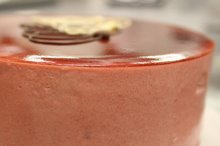
The particular Two Day Cake we cranked out this week was a miroir (meer-WAHR). The miroir (“mirror”) is a classic French dessert composed of layers of sponge cake which are moistened with syrup, filled and iced with a bavarois, or Bavarian, and topped with a thin layer of nappage. For clarification, allow me to state that the Bavarian I’m talking about here isn’t a person dressed in short pants with suspenders and a jaunty little feathered cap. No, this is a different kind of polka-dancer, where a purée of fruit (or another base of similar texture) is mixed with gelatine, and then folded together with whipped cream. The tricky part is the folding. People are afraid of folding, and understandably so; if you do it too forcefully, whatever it is you’re folding will deflate. Why not simply do it slowly, then? The Bavarian is the perfect answer. The gelatine which is melted into the base must necessarily be slightly warm, while the cream must be at least cool. The trick in folding them together is to do it gently enough so that the whipped cream isn’t completely deflated, but quickly enough that the gelatine doesn’t set when it comes in contact with the cream. Failing to accomplish the latter would result in a creamy sludge with what would seem like Gummy Bear droppings scattered throughout it, and we clearly can’t have that. Nappage (nah-PAZH), from way back in our first week, is essentially jelly with extra pectin. To construct the cake, you place a layer of sponge in a cake ring (think cake pan without sides), moisten it, top it with Bavarian, another layer of cake, and so forth, ending with a perfectly even and smooth layer of Bavarian. You chill this until set, and then pour a pool of warm nappage on the top, creating the mirror effect for which the dessert is named. Using a cake ring is doubly exciting. Not only can you create a cake with tremendously even sides, but when the time to remove the ring has come, you get to blowtorch it until it’s loose enough to simply slip off.
Some people have issues with the Bavarian (which is, by the way, what Bavarian cream really is; that stuff in donuts is a lie). The texture, admittedly, is a little unconventional, being somewhere between mousse and Jell-O, and nothing goes worse with cake than Jell-O. It’s also understandably off-putting to consider a gelatinous dairy product. Once you get past these things, though, it’s a pretty enjoyable dessert. The one I fashioned was strawberry (and before you raise the hypocrite alarm, let me state that both the purée and the nappage were (presumably) made from fruit when it was in season), decorated on top with some more voluntary cornet work.
What’s happening to me!?
It would seem that we’re in the middle of the two-or-more-day-cake phase. These days it’s always make the cake layers, freeze them, come back again, and do something to them. This has its advantages though; imagine this: you’re cutting a cake. Horizontally. Would you rather do this when the cake is nice and soft, hot, tender, and fresh from the oven? Or would you rather do it when the cake is a solid and forgiving block of what is basically frozen butter with a little starch, sugar, and egg thrown in to keep up appearances? Me too. So let’s proceed with the understanding that these creations of ours can be accomplished by actual human beings, right in our own homes. The two-day aspect isn’t continuous, so don’t be daunted. It’s not quite a lot like painting your house.
The particular Two Day Cake we cranked out this week was a miroir (meer-WAHR). The miroir (“mirror”) is a classic French dessert composed of layers of sponge cake which are moistened with syrup, filled and iced with a bavarois, or Bavarian, and topped with a thin layer of nappage. For clarification, allow me to state that the Bavarian I’m talking about here isn’t a person dressed in short pants with suspenders and a jaunty little feathered cap. No, this is a different kind of polka-dancer, where a purée of fruit (or another base of similar texture) is mixed with gelatine, and then folded together with whipped cream. The tricky part is the folding. People are afraid of folding, and understandably so; if you do it too forcefully, whatever it is you’re folding will deflate. Why not simply do it slowly, then? The Bavarian is the perfect answer. The gelatine which is melted into the base must necessarily be slightly warm, while the cream must be at least cool. The trick in folding them together is to do it gently enough so that the whipped cream isn’t completely deflated, but quickly enough that the gelatine doesn’t set when it comes in contact with the cream. Failing to accomplish the latter would result in a creamy sludge with what would seem like Gummy Bear droppings scattered throughout it, and we clearly can’t have that. Nappage (nah-PAZH), from way back in our first week, is essentially jelly with extra pectin. To construct the cake, you place a layer of sponge in a cake ring (think cake pan without sides), moisten it, top it with Bavarian, another layer of cake, and so forth, ending with a perfectly even and smooth layer of Bavarian. You chill this until set, and then pour a pool of warm nappage on the top, creating the mirror effect for which the dessert is named. Using a cake ring is doubly exciting. Not only can you create a cake with tremendously even sides, but when the time to remove the ring has come, you get to blowtorch it until it’s loose enough to simply slip off.
Some people have issues with the Bavarian (which is, by the way, what Bavarian cream really is; that stuff in donuts is a lie). The texture, admittedly, is a little unconventional, being somewhere between mousse and Jell-O, and nothing goes worse with cake than Jell-O. It’s also understandably off-putting to consider a gelatinous dairy product. Once you get past these things, though, it’s a pretty enjoyable dessert. The one I fashioned was strawberry (and before you raise the hypocrite alarm, let me state that both the purée and the nappage were (presumably) made from fruit when it was in season), decorated on top with some more voluntary cornet work.
What’s happening to me!?
Monday, April 23, 2007
Days 60 and 61: Light! And… not so much.
I’ll admit it: these haven’t been light little wisps of pastry we’ve been creating. You can, therefore, imagine my pleasure at finding that our most recent project was very different than the chocolate-cloaked-or-caramel-topped-or-sugar-enrobed-or-cream-cheese-infused items which we’ve been producing. We were finally introduced to the génoise, a classical French sponge cake which is always soaked with syrup during assembly. This cake is made by a whole lot of folding. Egg whites are whipped with a bit of sugar. Egg yolks are whipped with a bit of sugar. Dry ingredients, like flour, cornstarch, baking powder, and salt, are sifted together. The yolks are folded into the whites, and then the dry into the wet. That part (no fat other than egg yolks, did you notice?) people follow. It’s the whole syrup thing that sounds disagreeable when people first encounter it, but allow me to explain (as if you had a choice). Too much, yes – nasty, gross, soggy cake; who needs it? Too little, however, and you have an equally unappealing, dry layer which will make even the lactose-intolerant cry out for milk. Just the right amount, though, and you’re biting into a pastry that is the perfect (and I mean perfect) level of “moist,” that ever sought-after characteristic of cake. As with last week, we baked the layers with partners, but for the finishing we were left to our own devices; I chose raspberry. (Now, don’t think me some great hypocrite when it comes to seasonal fruit. We had to use something, and I chose raspberry. I’m not proud of it, but my pride does not extend to getting a failing grade for the day.) For the syrup, we used framboise, which is a raspberry eau-de-vie (a clear, unsweetened, 40% alcohol liquor distilled with the essence of a plant) combined with simple (sugar) syrup. After soaking the first layer, I topped it with pastry cream that had been scented with framboise as well, and dropped a few raspberries around in it. The second layer went on and got soaked. Then, the whole cake was iced with sweetened whipped cream, adorned with a few additional raspberries, and some sugared slivered almonds, just for some textural diversity. I will admit that when conceptualizing it, even I thought it would be overpoweringly raspberryish. It wasn’t though. It was airy and fruity and extremely cheerful. Like me, most of the time.
All balloons pop eventually. We countered this useless lightness with one of the heaviest and certainly best things so far, in the form of a chocolate chestnut cake. We soaked a layer of chocolate génoise with syrup flavored with kirsch, a cherry eau-de-vie (you couldn’t really taste the cherry, it just added depth; let’s move forward with that understanding). We then topped this first layer with alternating stripes of whipped ganache and chestnut buttercream. Other than that Christmas song, chestnuts don’t seem too popular here in good old America; they’re much more beloved in our parent England. In any case, they’re delightful, and one thing that further enhances their resident richness is to incorporate a puree of them into a buttercream. Trust me. The next layer of the cake was added and again soaked, and then, like that fancy cake of a few weeks ago, iced very evenly with whipped ganache. After chilling and firming, we poured liquid ganache over the whole thing, creating a shiny finish that’s only fitting for a cake this good. I decorated mine with some cornet work, and decided to further embellish it with a little gold dust. This was a mistake, because there was moving air in the room. Not only did some random current cause my first attempt to add a dot of it turn into a comet-shape (and therefore all subsequent ones, in an attempt to be consistent), but when someone walked by quickly, a whole random smattering of it landed elsewhere on my cake’s surface. Not to worry, it’s gold dust. It’s innately appealing.
And once they took a bite, I’m sure they all forgot.
I’ll admit it: these haven’t been light little wisps of pastry we’ve been creating. You can, therefore, imagine my pleasure at finding that our most recent project was very different than the chocolate-cloaked-or-caramel-topped-or-sugar-enrobed-or-cream-cheese-infused items which we’ve been producing. We were finally introduced to the génoise, a classical French sponge cake which is always soaked with syrup during assembly. This cake is made by a whole lot of folding. Egg whites are whipped with a bit of sugar. Egg yolks are whipped with a bit of sugar. Dry ingredients, like flour, cornstarch, baking powder, and salt, are sifted together. The yolks are folded into the whites, and then the dry into the wet. That part (no fat other than egg yolks, did you notice?) people follow. It’s the whole syrup thing that sounds disagreeable when people first encounter it, but allow me to explain (as if you had a choice). Too much, yes – nasty, gross, soggy cake; who needs it? Too little, however, and you have an equally unappealing, dry layer which will make even the lactose-intolerant cry out for milk. Just the right amount, though, and you’re biting into a pastry that is the perfect (and I mean perfect) level of “moist,” that ever sought-after characteristic of cake. As with last week, we baked the layers with partners, but for the finishing we were left to our own devices; I chose raspberry. (Now, don’t think me some great hypocrite when it comes to seasonal fruit. We had to use something, and I chose raspberry. I’m not proud of it, but my pride does not extend to getting a failing grade for the day.) For the syrup, we used framboise, which is a raspberry eau-de-vie (a clear, unsweetened, 40% alcohol liquor distilled with the essence of a plant) combined with simple (sugar) syrup. After soaking the first layer, I topped it with pastry cream that had been scented with framboise as well, and dropped a few raspberries around in it. The second layer went on and got soaked. Then, the whole cake was iced with sweetened whipped cream, adorned with a few additional raspberries, and some sugared slivered almonds, just for some textural diversity. I will admit that when conceptualizing it, even I thought it would be overpoweringly raspberryish. It wasn’t though. It was airy and fruity and extremely cheerful. Like me, most of the time.
All balloons pop eventually. We countered this useless lightness with one of the heaviest and certainly best things so far, in the form of a chocolate chestnut cake. We soaked a layer of chocolate génoise with syrup flavored with kirsch, a cherry eau-de-vie (you couldn’t really taste the cherry, it just added depth; let’s move forward with that understanding). We then topped this first layer with alternating stripes of whipped ganache and chestnut buttercream. Other than that Christmas song, chestnuts don’t seem too popular here in good old America; they’re much more beloved in our parent England. In any case, they’re delightful, and one thing that further enhances their resident richness is to incorporate a puree of them into a buttercream. Trust me. The next layer of the cake was added and again soaked, and then, like that fancy cake of a few weeks ago, iced very evenly with whipped ganache. After chilling and firming, we poured liquid ganache over the whole thing, creating a shiny finish that’s only fitting for a cake this good. I decorated mine with some cornet work, and decided to further embellish it with a little gold dust. This was a mistake, because there was moving air in the room. Not only did some random current cause my first attempt to add a dot of it turn into a comet-shape (and therefore all subsequent ones, in an attempt to be consistent), but when someone walked by quickly, a whole random smattering of it landed elsewhere on my cake’s surface. Not to worry, it’s gold dust. It’s innately appealing.
And once they took a bite, I’m sure they all forgot.
Saturday, April 14, 2007
Days 58 and 59: Babies. Mamas.
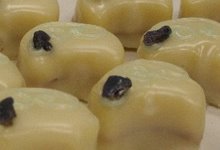
If you enjoy getting your entire being sticky by covering it in repeated coatings of pasty, semi-liquid sugar which will promptly solidify on your skin and thereafter mercilessly rip out any hair that had the misfortune to have been in the spot where this tacky sludge was originally applied, you might consider making some petits fours glacés (petty four glah-SAY). These little treasures have the dual condition of being adored by the general populace and abhorred by their creators. The assembly isn’t so esoteric: make a couple of frangipane layers, chill them, sandwich them with some strained and therefore seedless raspberry jam, chill them some more, cut them (perfectly), chill them one more time, then glaze and decorate them. That’s ostensibly easy. The common glaze for these is poured fondant (don’t struggle with it, just say FOND-int; you’re American, and that’s okay), which is essentially sugar with a small amount of water (and sometimes corn syrup) added, and mixed into an opaque and pearl-colored sludge. Said sludge pours beautifully as long as it’s somewhere within the generous temperature range of about 110 to 111 degrees Fahrenheit. Okay, it’s a little more generous than that, but truthfully, not much, and the real kicker is that if you heat it over say 120 degrees, it becomes pretty much useless. Oh, and when it hits the low end of its temperature range, as mentioned, it turns into a kind of diabetic plaster. We were to create twelve identical (a word which many of the members of class seemed to define quite subjectively) petits fours, plate them, and present them to Chef for evaluation. While we worked with partners during the assembly phase, our glazing and decorating was our own. For my miniature crescents, I opted for a pale yellow glaze with (slightly too) pale green adornments, finished with a small section of crystallized violet petal (which are gaining their own special place in my heart). Lovely. And to think: one satisfying bite took merely three days to prepare. Nonetheless, petits fours glacés are the darlings of the pastry world; indeed, those acquaintances of mine with whom they were shared gave me genuine kowtows. In my opinion (which you’re getting anyway), fondant looks very pretty, but it tastes like plain sugar (which is probably due to the fact that it’s plain sugar; I can’t say for sure; I’m not a chemist). To have flavored it with some oil-of-something-or-other – lemon, for example – would probably have been prudent. The marriage of the frangipane’s velvety smoothness and the raspberry jam’s enlivening tartness was presided over by the priest of sugar, who, despite his shallowness, truly made the ceremony what it was. Like I said, lovely. Just sort of a pain in the butt. (Then, most worthy weddings are.)
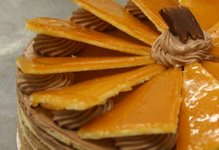
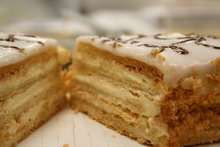
I like to think that every little one, sweet and/or annoying, is followed at some point by a grande dame whose dignity commands naught but the highest respect of everyone who interacts with her. Whether this tenet holds true in the real world or not, it definitely did in our class. Our particular stroller-pusher was Hungarian, and she goes by the name of dobos torte (if you want to keep it simple, say DOH-bohs tort; if you want to sound more well-informed, try DOH-bohsh; it’s closer). If some old-timer came up to me and said “Sonny, this torte is the reason WWI happened in the first place,” I might have believed him (ignoring the fact that an old-timer using the word “torte” could be somewhat off-putting). An impractically thin layer of moist yellow cake is topped with chocolate buttercream. This is then repeated. It is then repeated again. And again. Once more, and again. One final time, and voilà, we’re not quite done. (And unless you’re actually in
Which was, as usual, totally worth it.
Sunday, April 1, 2007
Days 54, 55, 56, and 57: Taste vs. Taste
Things are really starting to get out of hand. Cakes shouldn’t be this good; it’s just not fair. First, I suppose I should give you a little background. You know those shows on TV where they do the competitions and all these women from various parts of our probably too-large country coalesce for the purpose of seeing which person can make the best cake? When I watch those programs, I always feel encapsulated in a feeling I can only describe as a sort of nonviolent terror, and it’s a feeling that I reserve exclusively for these shows. I think they shouldn’t call them Who Can Make The Best Cake shows, but perhaps something more along the lines of Which Enormous Cake Can Hold The Most Objects competitions. Even as I walked past a darkened bakery window in Manhattan sometime between late last night and early this morning, I saw a large white cake (at least six inches high) topped with a rim of enormous (out-of-season) strawberries. I thought to myself, Do people really like eating whole strawberries at the back of a piece of cake? Well, do you? I don’t understand the appeal of having an entire Oreo sticking out from the top of an otherwise harmless piece of cake. People seem to confuse jabbing with decorating. (I hope I’m not being too snobby here, but is that elegant? Really?) In any event, Chef said that we weren’t going to be making any “diner cakes,” and it was at that moment that two things transpired within my mind. First, I found a name for this phenomenon, which has for so long repulsed me. Perhaps somewhat more significantly, though, I realized that I was not alone in finding these the-higher-the-better confections to be revolting. That promise laid before us, I began to believe that our quest to perfection in cake was on the right track. I suppose every great teacher says one thing that leaves a mark.
It dawns on me also that I should explain how we’re filling these cakes, since I’ve explained the later step of icing. We cut them in half and then spread frosting in between the layers. There.
We began the week with a cake that was positively transporting. We first baked some dense, fudgy chocolate cake (clearly, a good start). Now, you occasionally see recipes that would have you take these cake layers and fill and frost them with a dense chocolate frosting, and then glaze it with chocolate, and then decorate it with chocolate, and then possibly even serve it with a chocolate sauce, and call it something like Chocolate Death. Yes, we get it, people love chocolate; you’re reading from one such person even now. But the truth is that many people, even those who wouldn’t admit it, like me, find desserts of this kind to be too rich. Beyond being too rich, though, they fail also to treat the eater to the ethereally perfect balance of texture that a good cake has. Well, there are reasons we’re learning all this. We did Pretty Icing Lesson No. 2 with the lightest frosting possible: whipped cream. While there’s nothing wrong with clean, fresh, lightly sweetened whipped cream, no one on my team argued when we were assigned caramel whipped cream. In a nutshell, this is made by melting some sugar into caramel, then (very carefully) pouring some cream into it, chilling it, and whipping it up. Really simple, and beyond excellent. The resultant cake, which I suppose would be dense chocolate cake filled and iced with caramel whipped cream, was stupefyingly good. (Stupefyingly might not even be a word but it’s the only one that makes any sense.) When I brought this cake to work the following morning, it was like watching some sort of nature show. Not the kind where they’re all cute and cuddly, either, but more like one where the entire pack has been hunting unsuccessfully all summer, until this one particular day.
Don’t worry, bliss was soon supplanted as the ruling emotion in the class. We moved on to working with marzipan. Marzipan, which is a thick, sweet almond paste, can be sculpted into any shape which it will hold, barring natural disaster, indefinitely. When appropriately tinted, it can be used to create an infinite variety of decorations. We began with the most cliché design (and therefore the one we’ll need to know best): roses. My first try was less than triumphant, but on repeating it the second day I felt I had made enough progress to display a photograph. To do this, you flatten small balls of tinted marzipan on the table, further thinning the edges with the back of an immaculate spoon. You then filet the marzipan discs from the table with a sharp knife, and then roll each into a specific shape – the first of course being the center of the rose, with the petals following. It’s a good start.
We concluded the week with a cake that still cannot trump the aforementioned one in sheer eating pleasure, but whose appearance leapt far to the front of the elegance line. We used one batch of ganache for two different tasks – icing and glazing. We each took about half of our barely cooled, still liquid ganache, and whipped it. We used this whipped ganache to fill our yellow cake layers and to ice the tops and sides of our cakes. After letting the cakes solidify in the freezer, we reheated the now cooled remaining half of our ganache to a liquid consistency, and proceeded to pour it over them, enrobing them entirely in a satiny, mirror-finish layer of sumptuous dark chocolate. Combined with a bit of cornet work, some chocolate shavings, a little gold leaf, and a ribbon, I produced my first cake of showpiece appearance. I brought this one, too, into work the following morning. It was greeted with oohs and aahs and many declarations that it looked “too good to eat.”
How quickly our convictions crumble.
Things are really starting to get out of hand. Cakes shouldn’t be this good; it’s just not fair. First, I suppose I should give you a little background. You know those shows on TV where they do the competitions and all these women from various parts of our probably too-large country coalesce for the purpose of seeing which person can make the best cake? When I watch those programs, I always feel encapsulated in a feeling I can only describe as a sort of nonviolent terror, and it’s a feeling that I reserve exclusively for these shows. I think they shouldn’t call them Who Can Make The Best Cake shows, but perhaps something more along the lines of Which Enormous Cake Can Hold The Most Objects competitions. Even as I walked past a darkened bakery window in Manhattan sometime between late last night and early this morning, I saw a large white cake (at least six inches high) topped with a rim of enormous (out-of-season) strawberries. I thought to myself, Do people really like eating whole strawberries at the back of a piece of cake? Well, do you? I don’t understand the appeal of having an entire Oreo sticking out from the top of an otherwise harmless piece of cake. People seem to confuse jabbing with decorating. (I hope I’m not being too snobby here, but is that elegant? Really?) In any event, Chef said that we weren’t going to be making any “diner cakes,” and it was at that moment that two things transpired within my mind. First, I found a name for this phenomenon, which has for so long repulsed me. Perhaps somewhat more significantly, though, I realized that I was not alone in finding these the-higher-the-better confections to be revolting. That promise laid before us, I began to believe that our quest to perfection in cake was on the right track. I suppose every great teacher says one thing that leaves a mark.
It dawns on me also that I should explain how we’re filling these cakes, since I’ve explained the later step of icing. We cut them in half and then spread frosting in between the layers. There.
We began the week with a cake that was positively transporting. We first baked some dense, fudgy chocolate cake (clearly, a good start). Now, you occasionally see recipes that would have you take these cake layers and fill and frost them with a dense chocolate frosting, and then glaze it with chocolate, and then decorate it with chocolate, and then possibly even serve it with a chocolate sauce, and call it something like Chocolate Death. Yes, we get it, people love chocolate; you’re reading from one such person even now. But the truth is that many people, even those who wouldn’t admit it, like me, find desserts of this kind to be too rich. Beyond being too rich, though, they fail also to treat the eater to the ethereally perfect balance of texture that a good cake has. Well, there are reasons we’re learning all this. We did Pretty Icing Lesson No. 2 with the lightest frosting possible: whipped cream. While there’s nothing wrong with clean, fresh, lightly sweetened whipped cream, no one on my team argued when we were assigned caramel whipped cream. In a nutshell, this is made by melting some sugar into caramel, then (very carefully) pouring some cream into it, chilling it, and whipping it up. Really simple, and beyond excellent. The resultant cake, which I suppose would be dense chocolate cake filled and iced with caramel whipped cream, was stupefyingly good. (Stupefyingly might not even be a word but it’s the only one that makes any sense.) When I brought this cake to work the following morning, it was like watching some sort of nature show. Not the kind where they’re all cute and cuddly, either, but more like one where the entire pack has been hunting unsuccessfully all summer, until this one particular day.
Don’t worry, bliss was soon supplanted as the ruling emotion in the class. We moved on to working with marzipan. Marzipan, which is a thick, sweet almond paste, can be sculpted into any shape which it will hold, barring natural disaster, indefinitely. When appropriately tinted, it can be used to create an infinite variety of decorations. We began with the most cliché design (and therefore the one we’ll need to know best): roses. My first try was less than triumphant, but on repeating it the second day I felt I had made enough progress to display a photograph. To do this, you flatten small balls of tinted marzipan on the table, further thinning the edges with the back of an immaculate spoon. You then filet the marzipan discs from the table with a sharp knife, and then roll each into a specific shape – the first of course being the center of the rose, with the petals following. It’s a good start.
We concluded the week with a cake that still cannot trump the aforementioned one in sheer eating pleasure, but whose appearance leapt far to the front of the elegance line. We used one batch of ganache for two different tasks – icing and glazing. We each took about half of our barely cooled, still liquid ganache, and whipped it. We used this whipped ganache to fill our yellow cake layers and to ice the tops and sides of our cakes. After letting the cakes solidify in the freezer, we reheated the now cooled remaining half of our ganache to a liquid consistency, and proceeded to pour it over them, enrobing them entirely in a satiny, mirror-finish layer of sumptuous dark chocolate. Combined with a bit of cornet work, some chocolate shavings, a little gold leaf, and a ribbon, I produced my first cake of showpiece appearance. I brought this one, too, into work the following morning. It was greeted with oohs and aahs and many declarations that it looked “too good to eat.”
How quickly our convictions crumble.
Saturday, March 31, 2007
Days 51, 52, and 53: Pounds. Carrots. Rums.
Cake has begun, much to the danger of all around me. The threat was apparent from the very beginning, when we started with that commonest of all cakes, the pound cake.
There are varying schools of thought with pound cake. In the first method, the flour and sugar are creamed together very thoroughly with the butter. (Don’t even think about gluten; there’s way too much fat sitting between each little starch granule for them ever to become acquainted.) The liquids are then added and away it bakes. I tend to think of this as the Southern Method, since any pound cake I’ve had from the South has been of the texture this produces, which is light, fluffy, crumbly, and perfectly balanced with a clear flavor. The other method, which simply to equalize the matter I consider the Northern Method, is what you might think of as more traditional, if you’re from up this way. The butter and sugar are creamed together, eggs are beaten in, and then milk is added in alternating steps with the remaining dry ingredients. This results in a cake of a denser, less crumbly texture, and a richer buttery flavor (but not the oily quality of the plastic-wrapped slices at every deli in New York). Both cakes having completely disappeared with equal speed leaves me to conclude that neither the North nor the South will win this particular war. Both are good, in their own ways, and I can’t personally choose which I prefer. Unless, that is, we’re talking about the next pound cake, which I must have made with one or the other of the methods… forgive me if I can’t remember. I was probably distracted by the rum and hazelnuts we were adding.
We also created another cake that’s ubiquitous and overridingly popular: carrot cake with cream cheese frosting. A terrifyingly easy cake to make, we filled and then frosted ours with delectable cream cheese buttercream. I’m certain that the icing recipe made nearly double what we needed, to accommodate the huge amount of it we’d eat during the process. (I was reminded of the butter-tasting incident from Day 2, only whilst high on sugar.) We learned the messy way to frost a cake. It wasn’t a primary concern that things weren’t perfect, since we were to freeze the cakes overnight and trim them the next day. This is when a pall was cast over my carrot cake, after having promised a piece of it to no fewer than seven people. I had mistakenly put it in the fridge instead of the freezer. On the day we were to be trimming, mine was too soft to cut properly, so into the freezer it went to be cut up during the next lesson. When I arrived at that lesson, with the mob of people who did not get their carrot cake barely at bay behind me, I was confounded to find that it had disappeared from the freezer, nowhere to be found. (My theory, after noticing that a large amount of ice crystals had accumulated in the freezer, was that my cake too became covered in them, and someone threw it away. I’m not a very suspicious person, I guess.) I suppose I learned an important lesson, even if it had nothing to do with baking or frosting: don’t promise people carrot cake, just surprise them with it.
We finished the week with our first lesson in How to Frost Prettily. I don’t know if it’s an industry secret or not, but here goes. Put your cake layer on a round of cardboard that’s about the size of the cake. Spread big globs of frosting over it, and top it with the next layer. You then want to ensure that the cardboard at the bottom is about one-quarter inch larger than the cake all the way around. If it isn’t, trim the cake with a bread knife, without worrying about trimming it perfectly roundly. Then, with a metal spatula, put great heaps of frosting on the sides, using the cardboard as a guide by scraping against it. Allow the frosting to mount up past the top edge, and do this all the way around. Then, spread more piles of frosting on the top, going past the side edges. Don’t freak out about it, just do your best to make it smooth and level. Then, again using the cardboard as a guide, scrape the extra frosting off the sides, smoothing as you go. It’s pretty foolproof if you have a little patience and keep your spatula clean. If you expect it to look flawless or don’t have at least a little patience, just go buy a cake. We iced our white cake with a lightly rum-flavored buttercream, which I cannot recommend wholeheartedly enough.
Making all these cakes one after another made me come to wonder why in the world anyone with more than 6 minutes would bother using a boxed mix. It’s tremendously easy to do it properly from scratch, the only aspect approaching difficulty being the finishing, which you’d have to do in any case. The flavor of a homemade cake is pure butter and vanilla (and, as the case may be, chocolate or carrot or spice), and the sublime texture will make you question why you would ever even admit the boxed stuff was food. It seems like the lesson of this short first week of cake might simply have been to show us all how simple it really is.
Even easier than pie.
Cake has begun, much to the danger of all around me. The threat was apparent from the very beginning, when we started with that commonest of all cakes, the pound cake.
There are varying schools of thought with pound cake. In the first method, the flour and sugar are creamed together very thoroughly with the butter. (Don’t even think about gluten; there’s way too much fat sitting between each little starch granule for them ever to become acquainted.) The liquids are then added and away it bakes. I tend to think of this as the Southern Method, since any pound cake I’ve had from the South has been of the texture this produces, which is light, fluffy, crumbly, and perfectly balanced with a clear flavor. The other method, which simply to equalize the matter I consider the Northern Method, is what you might think of as more traditional, if you’re from up this way. The butter and sugar are creamed together, eggs are beaten in, and then milk is added in alternating steps with the remaining dry ingredients. This results in a cake of a denser, less crumbly texture, and a richer buttery flavor (but not the oily quality of the plastic-wrapped slices at every deli in New York). Both cakes having completely disappeared with equal speed leaves me to conclude that neither the North nor the South will win this particular war. Both are good, in their own ways, and I can’t personally choose which I prefer. Unless, that is, we’re talking about the next pound cake, which I must have made with one or the other of the methods… forgive me if I can’t remember. I was probably distracted by the rum and hazelnuts we were adding.
We also created another cake that’s ubiquitous and overridingly popular: carrot cake with cream cheese frosting. A terrifyingly easy cake to make, we filled and then frosted ours with delectable cream cheese buttercream. I’m certain that the icing recipe made nearly double what we needed, to accommodate the huge amount of it we’d eat during the process. (I was reminded of the butter-tasting incident from Day 2, only whilst high on sugar.) We learned the messy way to frost a cake. It wasn’t a primary concern that things weren’t perfect, since we were to freeze the cakes overnight and trim them the next day. This is when a pall was cast over my carrot cake, after having promised a piece of it to no fewer than seven people. I had mistakenly put it in the fridge instead of the freezer. On the day we were to be trimming, mine was too soft to cut properly, so into the freezer it went to be cut up during the next lesson. When I arrived at that lesson, with the mob of people who did not get their carrot cake barely at bay behind me, I was confounded to find that it had disappeared from the freezer, nowhere to be found. (My theory, after noticing that a large amount of ice crystals had accumulated in the freezer, was that my cake too became covered in them, and someone threw it away. I’m not a very suspicious person, I guess.) I suppose I learned an important lesson, even if it had nothing to do with baking or frosting: don’t promise people carrot cake, just surprise them with it.
We finished the week with our first lesson in How to Frost Prettily. I don’t know if it’s an industry secret or not, but here goes. Put your cake layer on a round of cardboard that’s about the size of the cake. Spread big globs of frosting over it, and top it with the next layer. You then want to ensure that the cardboard at the bottom is about one-quarter inch larger than the cake all the way around. If it isn’t, trim the cake with a bread knife, without worrying about trimming it perfectly roundly. Then, with a metal spatula, put great heaps of frosting on the sides, using the cardboard as a guide by scraping against it. Allow the frosting to mount up past the top edge, and do this all the way around. Then, spread more piles of frosting on the top, going past the side edges. Don’t freak out about it, just do your best to make it smooth and level. Then, again using the cardboard as a guide, scrape the extra frosting off the sides, smoothing as you go. It’s pretty foolproof if you have a little patience and keep your spatula clean. If you expect it to look flawless or don’t have at least a little patience, just go buy a cake. We iced our white cake with a lightly rum-flavored buttercream, which I cannot recommend wholeheartedly enough.
Making all these cakes one after another made me come to wonder why in the world anyone with more than 6 minutes would bother using a boxed mix. It’s tremendously easy to do it properly from scratch, the only aspect approaching difficulty being the finishing, which you’d have to do in any case. The flavor of a homemade cake is pure butter and vanilla (and, as the case may be, chocolate or carrot or spice), and the sublime texture will make you question why you would ever even admit the boxed stuff was food. It seems like the lesson of this short first week of cake might simply have been to show us all how simple it really is.
Even easier than pie.
Thursday, March 29, 2007
Day 50: Test. Paper. Halfway.
Mostly logistical at this point, so let’s keep this brief.
We had the usual written exam, which I aced.
We had the usual practical exam, consisting of creating soft rolls to the point of readiness for the oven, but without baking (although one other student and I stayed late to bake ours, since they looked particularly good), and then making puff pastry by hand. Both went very well and I received full credit.
I also did pretty well on the paper (which, for those of you who just can’t get enough verboseness, can be found here). My topic being Middle Eastern baking, a look at the region’s breads was highly informative in terms of human history and political geography, as well as of the breads themselves.
The report card we received the next week showed me at a .07 reduction in my overall GPA due to the day that I was out sick – the fact that I made the project for that day at home, perfectly, using my own equipment and ingredients, apparently notwithstanding. I might push my luck on this one; I’ll keep you posted. If I felt it were fair I wouldn’t mind so much.
Halfway done!
Mostly logistical at this point, so let’s keep this brief.
We had the usual written exam, which I aced.
We had the usual practical exam, consisting of creating soft rolls to the point of readiness for the oven, but without baking (although one other student and I stayed late to bake ours, since they looked particularly good), and then making puff pastry by hand. Both went very well and I received full credit.
I also did pretty well on the paper (which, for those of you who just can’t get enough verboseness, can be found here). My topic being Middle Eastern baking, a look at the region’s breads was highly informative in terms of human history and political geography, as well as of the breads themselves.
The report card we received the next week showed me at a .07 reduction in my overall GPA due to the day that I was out sick – the fact that I made the project for that day at home, perfectly, using my own equipment and ingredients, apparently notwithstanding. I might push my luck on this one; I’ll keep you posted. If I felt it were fair I wouldn’t mind so much.
Halfway done!
Sunday, March 25, 2007
Days 47, 48, and 49: Coating. Tunneling. Snapping.
We continued in this last week of our second quarter with the process of lamination. Any dough which is rolled thin, spread with fat, folded, and rolled thin again (this process being repeated any number of times) is called a “laminated” dough. A very common one was the puff pastry we had made the week before; a very uncommon one (that I know only through my research on Middle Eastern breads for our second final project) is malooga, a Yemeni flatbread which is prepared in the same way. The one most recognized around the world though, is probably the croissant, which we finally got to this week. Surely right on the croissant’s heels is the Danish, which we also made.
The origin of the croissant goes (something) like this: in Vienna (yes, which is not in France), bakers were working in the very early morning, when they heard alarming noises coming from what seemed to be underneath the city. They alerted the authorities, and lo and behold, the Ottomans were tunneling their way under the city to sack it. The military responded and before you knew it, the invaders were squashed in one fell stroke. The bakers were credited with saving the city, and, in recognition of their heroism, they were graciously permitted to create a new pastry. (Rodney Dangerfield should have been telling this story.) They thus created the croissant, its crescent shape a sort of middle finger to the Ottoman Empire (who symbolized itself with the crescent, as the Turkish flag still does). But I digress.
The major difference between puff pastry and both croissant and Danish doughs is that the latter two contain yeast. Obviously this creates rise, but that fact is fairly significant when you compare it with puff pastry. There, the only way to obtain a perfect rise is through a thorough and perfect rolling and folding technique, allowing the moisture in the butter to push the many layers of dough up and apart with stunning ease and surprising efficacy. With these new two doughs, however, the fact that the yeast aids the rise allows us to create it with fewer turns of dough, and, at the same time, promotes a degree of evenness in the rise of the final product.
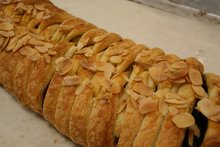
We began with Danish. This smooth and cooperative dough (ok, sorry to interrupt, but I have a rather large digression on which to embark: My core philosophy with food is, and long has been, that it should be comprised of natural, whole, real ingredients – ingredients which we can identify. As my food education continues, both leisurely and formally, I have begun to learn that certain things like xanthan-, carageenan-, and guar gums are natural plant derivatives, so my derision of them has concluded. However, thanks to food shortages and industrialization efforts during and after WWII, there are other widespread and odious ingredients in food today, and they’re dually demonic. The only thing they contribute to food, by and large, is stability; not flavor, not texture, not quality, simply shelf-life. Meanwhile, as is coming to light even now, hydrogenated fats are… well, they’re just not good for you. Same goes for high-fructose corn syrups, polysorbates, mono- and di-glycerides, modified food starch… what are all these things? Not to sound prideful but I’ve read a fair amount about food science and I know where they come from and how they’re made, but I still don’t quite know what they are. When something is derived from “pineapple,” I get it. I can imagine it. When something is derived from “polyoxylated sorbitol and oleic acid,” you really start to lose me; I’ve never seen that on any tree and I’ve been in a few forests now. If all this sounds like hippie, tree-hugging nonsense, examine this trend: heart disease, cancer, diabetes, and food allergies are at an all-time high for us as a species, and these conditions are especially prevalent in regions whose food supply is tainted with these things. Won’t you please join me in crusading, at least in your own daily eating and cooking, for pure, clean, true food? It’s not your fault or mine that these things have become staples in the American diet, but we can do something about it. That being said, I should mention that Danish dough) is one of the few products that benefits from the use of margarine. It gives the dough an even softer texture, and the butter flavor of the margarine doesn’t come across as chemical or overpowering in the final product. We did, however, use butter in ours, kneading an amount of flour into it, and the final product was truly excellent. We formed ours into a number of fruit envelopes (the shape most closely resembling what most of us think of as “Danish”), and into one long prune-filled braid.
Proceeding, we made croissants. (Here’s an oddity for you: all my snobbery and French lessons aside, I hope you find it enlivening that I say cruh-‘sahnts, not ‘cghrwa-soh. It’s okay, we live in America.) For as many times as I’ve failed in making these at home, it went fairly well. We didn’t have enough time to allow them to rise properly, so they didn’t expand to the light and airy state that anyone enjoying a croissant would generally prefer. However, for some reason not too many of us complained about a product that was a little heavier and in which the butter was more concentrated. In general, not a huge event. Next time, though, watch out.
We followed these slightly off but clearly understood pastries with a different sort of croissant. Pains au chocolat, or “chocolate croissants” as they’re callously called here, share the top of my Great Pyramid of Favorites with crème brûlée and donuts. Since I left France, I’ve been trying to find a good one; this above all other food matters so far has been my grail quest. The defining factor of a good one, for my money, is a certain amount of “snap” to the chocolate; it shouldn’t be soft. This way, rather than eating a goo-filled croissant, you’re eating a real croissant at the same time as real chocolate, and what could possibly be better than that? Finding a proper one of these is a true quandary. Certainly don’t get one from a coffee-shop chain; their chocolate is downright mushy. Corporations aren’t the only ones who missed the boat; it’s hard to find a good one even from a great bakery. When we made them in class, I was a little ho-hum, my longtime discouragement about this nitpicky little detail a foregone conclusion at this point. We were each given a number of small, narrow bars of compound chocolate (that is, chocolate which has had a small amount of vegetable oil mixed in, so it doesn’t break down in the heat of the oven – it’s all-natural, mind you!). We enrobed these bars in small rectangles of croissant dough, sealing them on the bottom. Shortly after pulling them from the oven, the fact that they were really too hot to eat was trumped by the incredible aroma filling the room, and we all set upon them like a pack of hyenas at the end of a thin year. The chocolate, of course, was gooey, but the pain au chocolat was heavenly anyway. The next morning, I packed two of these delightful creations for breakfast. When I bit into the first I was slightly more exuberant at my desk than I may have been in quite some time… for the first time in nine years, my teeth stopped at the chocolate and I had to bite just a tiny bit harder to break through it before it surrendered itself to my startled, happy mouth. Not a minor difference. When that snap is there, the chocolate melts at the same moment that the flavor of the butter comes to full light, and both of them float away together on a raft of gossamer pastry.
Sailing into the ecstatic glory of a perfect sunset.
We continued in this last week of our second quarter with the process of lamination. Any dough which is rolled thin, spread with fat, folded, and rolled thin again (this process being repeated any number of times) is called a “laminated” dough. A very common one was the puff pastry we had made the week before; a very uncommon one (that I know only through my research on Middle Eastern breads for our second final project) is malooga, a Yemeni flatbread which is prepared in the same way. The one most recognized around the world though, is probably the croissant, which we finally got to this week. Surely right on the croissant’s heels is the Danish, which we also made.
The origin of the croissant goes (something) like this: in Vienna (yes, which is not in France), bakers were working in the very early morning, when they heard alarming noises coming from what seemed to be underneath the city. They alerted the authorities, and lo and behold, the Ottomans were tunneling their way under the city to sack it. The military responded and before you knew it, the invaders were squashed in one fell stroke. The bakers were credited with saving the city, and, in recognition of their heroism, they were graciously permitted to create a new pastry. (Rodney Dangerfield should have been telling this story.) They thus created the croissant, its crescent shape a sort of middle finger to the Ottoman Empire (who symbolized itself with the crescent, as the Turkish flag still does). But I digress.
The major difference between puff pastry and both croissant and Danish doughs is that the latter two contain yeast. Obviously this creates rise, but that fact is fairly significant when you compare it with puff pastry. There, the only way to obtain a perfect rise is through a thorough and perfect rolling and folding technique, allowing the moisture in the butter to push the many layers of dough up and apart with stunning ease and surprising efficacy. With these new two doughs, however, the fact that the yeast aids the rise allows us to create it with fewer turns of dough, and, at the same time, promotes a degree of evenness in the rise of the final product.
We began with Danish. This smooth and cooperative dough (ok, sorry to interrupt, but I have a rather large digression on which to embark: My core philosophy with food is, and long has been, that it should be comprised of natural, whole, real ingredients – ingredients which we can identify. As my food education continues, both leisurely and formally, I have begun to learn that certain things like xanthan-, carageenan-, and guar gums are natural plant derivatives, so my derision of them has concluded. However, thanks to food shortages and industrialization efforts during and after WWII, there are other widespread and odious ingredients in food today, and they’re dually demonic. The only thing they contribute to food, by and large, is stability; not flavor, not texture, not quality, simply shelf-life. Meanwhile, as is coming to light even now, hydrogenated fats are… well, they’re just not good for you. Same goes for high-fructose corn syrups, polysorbates, mono- and di-glycerides, modified food starch… what are all these things? Not to sound prideful but I’ve read a fair amount about food science and I know where they come from and how they’re made, but I still don’t quite know what they are. When something is derived from “pineapple,” I get it. I can imagine it. When something is derived from “polyoxylated sorbitol and oleic acid,” you really start to lose me; I’ve never seen that on any tree and I’ve been in a few forests now. If all this sounds like hippie, tree-hugging nonsense, examine this trend: heart disease, cancer, diabetes, and food allergies are at an all-time high for us as a species, and these conditions are especially prevalent in regions whose food supply is tainted with these things. Won’t you please join me in crusading, at least in your own daily eating and cooking, for pure, clean, true food? It’s not your fault or mine that these things have become staples in the American diet, but we can do something about it. That being said, I should mention that Danish dough) is one of the few products that benefits from the use of margarine. It gives the dough an even softer texture, and the butter flavor of the margarine doesn’t come across as chemical or overpowering in the final product. We did, however, use butter in ours, kneading an amount of flour into it, and the final product was truly excellent. We formed ours into a number of fruit envelopes (the shape most closely resembling what most of us think of as “Danish”), and into one long prune-filled braid.
Proceeding, we made croissants. (Here’s an oddity for you: all my snobbery and French lessons aside, I hope you find it enlivening that I say cruh-‘sahnts, not ‘cghrwa-soh. It’s okay, we live in America.) For as many times as I’ve failed in making these at home, it went fairly well. We didn’t have enough time to allow them to rise properly, so they didn’t expand to the light and airy state that anyone enjoying a croissant would generally prefer. However, for some reason not too many of us complained about a product that was a little heavier and in which the butter was more concentrated. In general, not a huge event. Next time, though, watch out.
We followed these slightly off but clearly understood pastries with a different sort of croissant. Pains au chocolat, or “chocolate croissants” as they’re callously called here, share the top of my Great Pyramid of Favorites with crème brûlée and donuts. Since I left France, I’ve been trying to find a good one; this above all other food matters so far has been my grail quest. The defining factor of a good one, for my money, is a certain amount of “snap” to the chocolate; it shouldn’t be soft. This way, rather than eating a goo-filled croissant, you’re eating a real croissant at the same time as real chocolate, and what could possibly be better than that? Finding a proper one of these is a true quandary. Certainly don’t get one from a coffee-shop chain; their chocolate is downright mushy. Corporations aren’t the only ones who missed the boat; it’s hard to find a good one even from a great bakery. When we made them in class, I was a little ho-hum, my longtime discouragement about this nitpicky little detail a foregone conclusion at this point. We were each given a number of small, narrow bars of compound chocolate (that is, chocolate which has had a small amount of vegetable oil mixed in, so it doesn’t break down in the heat of the oven – it’s all-natural, mind you!). We enrobed these bars in small rectangles of croissant dough, sealing them on the bottom. Shortly after pulling them from the oven, the fact that they were really too hot to eat was trumped by the incredible aroma filling the room, and we all set upon them like a pack of hyenas at the end of a thin year. The chocolate, of course, was gooey, but the pain au chocolat was heavenly anyway. The next morning, I packed two of these delightful creations for breakfast. When I bit into the first I was slightly more exuberant at my desk than I may have been in quite some time… for the first time in nine years, my teeth stopped at the chocolate and I had to bite just a tiny bit harder to break through it before it surrendered itself to my startled, happy mouth. Not a minor difference. When that snap is there, the chocolate melts at the same moment that the flavor of the butter comes to full light, and both of them float away together on a raft of gossamer pastry.
Sailing into the ecstatic glory of a perfect sunset.
Tuesday, March 13, 2007
Days 43, (44,) 45, and 46: You thought strudel was thin.
It seems I forgot to mention what was probably the most enjoyable aspect of making strudel, so allow me to regress for a moment. The thing which allows the dough to be stretched to such inconceivable dimensions is of course gluten. The fun part is getting that gluten to the appropriate emotional state to accommodate extension to such dramatic proportions. Where kneading is enough for bread dough, which needs the gluten to be strong enough to trap air but not much stronger, strudel's gluten obviously needs to be much more thoroughly developed and forgiving. The way you do this is to mix the dough, and then to bang the dickens out of it. You accomplish this is to grab the dough and then throw it - hard enough to use the word "slam" - against the table. Our recipe specified that this was to be done one hundred times; this number seemed a little arbitrary to me, but it was neither insufficient nor excessive, and it worked well. What this does is shock the gluten into formation by slamming the individual microscopic strands of it into one another so they adhere (basically), as opposed to kneading, which invites them together for a nice afternoon tea. As you might imagine, the room became a bit noisy for a short while, but the free therapy this activity provided lasted days.
During the week following strudel, our gaze narrowed to even thinner dough as we dedicated ourselves to four days with puff pastry, that Ionian column of the confectionery. The first type we prepared was "quick" puff pastry, which is made in very much the same way as flaky pie dough or pâte brisée. After this mealy dough is just brought together, with lumps of butter averaging the size of peas, it is rolled into a rectangle, which is given what is called a "double turn" - the short ends are folded into the center, and then the whole dough is folded along that center line. After adequate rest (no gluten here, thanks) and chilling, this process is repeated three times, resting again between every other fold or so. Quick puff pastry is only quicker than the classic version (hold on, we'll get there) when it comes to mixing... the same rules of rolling, folding, and resting apply to all forms of this dough. This dough doesn't puff up to quite the glory of its much more fussed-over cousin, but it still gives the baker adequate push for things like cinnamon-almond straws (which were unstoppable, truly) and little savory things, like the parmesan-paprika palmiers my team fashioned as well. We were also introduced to the mille-feuille, which translates directly as "thousand leaves." To make this very popular confection, the goal is to bake the sheets of dough, which tend to puff up quite vigorously, while at the same time trying to keep the dough as flat as possible. It basically involves a number of sheet pans stacked on top of one another and a lot of squashing things down in hot ovens. This seems silly I'm sure, but the result is a deeply rich and crispy layer of pastry, which flakes apart when broken. I can't visualize another way of making a preparation like this (and I would imagine that if there were, they might have shown it to us since it would most certainly have been simpler).
The next day was my first and hopefully last absence from class, due to strep throat. Our task for that particular Tuesday was the creation of classic puff pastry dough by hand. Not wanting to fall behind, I made it at home – I don't know how I happened to have on hand the two-and-a-half pounds of butter that this recipe requires, but not many people were too surprised when I mentioned that part, so I guess I shouldn't be either. I found the actual preparation of it rather enjoyable. When I returned to class the following day, my homemade dough in hand, everyone seemed moderately annoyed at having had to make puff pastry; and I didn't understand what the hubbub was. But then, when Chef looked at mine and said "huh," I began to think, Gee, maybe I'm not annoyed by doing it because I was doing it wrong. Any error I might have made in preparation, though, was obscured in the final baking process; everything came out pretty spiff. We used it to create more straws and palmiers (sweet this time), which puffed quite a bit more dramatically than those made from the quick dough, and also the classic pithiviers, which consists of two layers of puff pastry enclosing a mound of frangipane, a nut dough (almost always almond) whose fragrance and divine flavor permeate not only the pastry itself but the entire kitchen. Before baking, the top of the pithiviers is scored in a decorative pattern, and a look at the lines will give any potential employer a very accurate picture of just how advantageously neurotic their potential pastry cook will be. We also created an apple strip, which is a long rectangle of puff pastry bordered by slightly higher walls, lined with frangipane and sliced apples. As you can imagine, the variations here in terms of filling and topping are pretty much endless, and my mind wanders back to that gorgeous pastry cream-cognac-apricot concoction of a few weeks ago. (I'll let you know how that one goes.)
If I may say so, I felt I had reached a new level in my education with the final item I produced with this marvelous dough. I created a mille-feuille having used classic puff pastry, which necessitated quite a bit more pushing down during baking but resulted in a pastry layer that was impeccably even in color, flavor, and texture. These layers I alternated with lightened pastry cream, and then, having iced it with a white glaze and covered the sides in crumbled puff pastry (as is traditional), I actually opted to do some cornet work on top. (I know, I know!) The result, though, is a testimony to why we bothered learning cornet work to begin with. This may have been my favorite thing so far. Trumping all three hundred twelve earlier favorites.
So, the preparation. To make classic puff pastry does require a certain amount of patience, which is why most restaurants buy theirs in frozen sheets of only-slightly-lower quality than homemade. You begin by forming a soft dough, using cold water. This step goes fairly quickly, and while the dough rests somewhere, you proceed by kneading cold butter (which you soften by beating it into submission with a rolling pin) with a small amount of flour until the butter is completely smooth in texture. Ideally, the texture of the butter mixture will match the texture of the dough itself. The butter is formed into a block, the dough spread into a large square. The block of butter is then placed on the dough, which is wrapped around it and sealed tightly at all seams. This package of three layers, dough-butter-dough, is then rolled into a rectangle and given a double turn. This is repeated, with resting and chilling of course, three more times, resulting in a final product of (I think) 768 alternating layers of dough and butter (right?). When placed into an adequately hot oven, the moisture in the butter evaporates and very forcefully puffs the layers of dough apart. This works more evenly and impressively than quick puff pastry because between all those layers of dough, the butter is spread out in one giant, even sheet, not in several thousand large squashed pieces. The rise is quite tremendous, a mere eighth-inch piece of puff pastry rising to an inch or more, each impossibly thin layer visible from the side. When chewed, the resistance these layers provide to the teeth, as they are first pressed together and then shorn through, give puff pastry a unique and positively heavenly texture.
Let’s just say I had plenty of communion, then.
It seems I forgot to mention what was probably the most enjoyable aspect of making strudel, so allow me to regress for a moment. The thing which allows the dough to be stretched to such inconceivable dimensions is of course gluten. The fun part is getting that gluten to the appropriate emotional state to accommodate extension to such dramatic proportions. Where kneading is enough for bread dough, which needs the gluten to be strong enough to trap air but not much stronger, strudel's gluten obviously needs to be much more thoroughly developed and forgiving. The way you do this is to mix the dough, and then to bang the dickens out of it. You accomplish this is to grab the dough and then throw it - hard enough to use the word "slam" - against the table. Our recipe specified that this was to be done one hundred times; this number seemed a little arbitrary to me, but it was neither insufficient nor excessive, and it worked well. What this does is shock the gluten into formation by slamming the individual microscopic strands of it into one another so they adhere (basically), as opposed to kneading, which invites them together for a nice afternoon tea. As you might imagine, the room became a bit noisy for a short while, but the free therapy this activity provided lasted days.
During the week following strudel, our gaze narrowed to even thinner dough as we dedicated ourselves to four days with puff pastry, that Ionian column of the confectionery. The first type we prepared was "quick" puff pastry, which is made in very much the same way as flaky pie dough or pâte brisée. After this mealy dough is just brought together, with lumps of butter averaging the size of peas, it is rolled into a rectangle, which is given what is called a "double turn" - the short ends are folded into the center, and then the whole dough is folded along that center line. After adequate rest (no gluten here, thanks) and chilling, this process is repeated three times, resting again between every other fold or so. Quick puff pastry is only quicker than the classic version (hold on, we'll get there) when it comes to mixing... the same rules of rolling, folding, and resting apply to all forms of this dough. This dough doesn't puff up to quite the glory of its much more fussed-over cousin, but it still gives the baker adequate push for things like cinnamon-almond straws (which were unstoppable, truly) and little savory things, like the parmesan-paprika palmiers my team fashioned as well. We were also introduced to the mille-feuille, which translates directly as "thousand leaves." To make this very popular confection, the goal is to bake the sheets of dough, which tend to puff up quite vigorously, while at the same time trying to keep the dough as flat as possible. It basically involves a number of sheet pans stacked on top of one another and a lot of squashing things down in hot ovens. This seems silly I'm sure, but the result is a deeply rich and crispy layer of pastry, which flakes apart when broken. I can't visualize another way of making a preparation like this (and I would imagine that if there were, they might have shown it to us since it would most certainly have been simpler).
The next day was my first and hopefully last absence from class, due to strep throat. Our task for that particular Tuesday was the creation of classic puff pastry dough by hand. Not wanting to fall behind, I made it at home – I don't know how I happened to have on hand the two-and-a-half pounds of butter that this recipe requires, but not many people were too surprised when I mentioned that part, so I guess I shouldn't be either. I found the actual preparation of it rather enjoyable. When I returned to class the following day, my homemade dough in hand, everyone seemed moderately annoyed at having had to make puff pastry; and I didn't understand what the hubbub was. But then, when Chef looked at mine and said "huh," I began to think, Gee, maybe I'm not annoyed by doing it because I was doing it wrong. Any error I might have made in preparation, though, was obscured in the final baking process; everything came out pretty spiff. We used it to create more straws and palmiers (sweet this time), which puffed quite a bit more dramatically than those made from the quick dough, and also the classic pithiviers, which consists of two layers of puff pastry enclosing a mound of frangipane, a nut dough (almost always almond) whose fragrance and divine flavor permeate not only the pastry itself but the entire kitchen. Before baking, the top of the pithiviers is scored in a decorative pattern, and a look at the lines will give any potential employer a very accurate picture of just how advantageously neurotic their potential pastry cook will be. We also created an apple strip, which is a long rectangle of puff pastry bordered by slightly higher walls, lined with frangipane and sliced apples. As you can imagine, the variations here in terms of filling and topping are pretty much endless, and my mind wanders back to that gorgeous pastry cream-cognac-apricot concoction of a few weeks ago. (I'll let you know how that one goes.)
If I may say so, I felt I had reached a new level in my education with the final item I produced with this marvelous dough. I created a mille-feuille having used classic puff pastry, which necessitated quite a bit more pushing down during baking but resulted in a pastry layer that was impeccably even in color, flavor, and texture. These layers I alternated with lightened pastry cream, and then, having iced it with a white glaze and covered the sides in crumbled puff pastry (as is traditional), I actually opted to do some cornet work on top. (I know, I know!) The result, though, is a testimony to why we bothered learning cornet work to begin with. This may have been my favorite thing so far. Trumping all three hundred twelve earlier favorites.
So, the preparation. To make classic puff pastry does require a certain amount of patience, which is why most restaurants buy theirs in frozen sheets of only-slightly-lower quality than homemade. You begin by forming a soft dough, using cold water. This step goes fairly quickly, and while the dough rests somewhere, you proceed by kneading cold butter (which you soften by beating it into submission with a rolling pin) with a small amount of flour until the butter is completely smooth in texture. Ideally, the texture of the butter mixture will match the texture of the dough itself. The butter is formed into a block, the dough spread into a large square. The block of butter is then placed on the dough, which is wrapped around it and sealed tightly at all seams. This package of three layers, dough-butter-dough, is then rolled into a rectangle and given a double turn. This is repeated, with resting and chilling of course, three more times, resulting in a final product of (I think) 768 alternating layers of dough and butter (right?). When placed into an adequately hot oven, the moisture in the butter evaporates and very forcefully puffs the layers of dough apart. This works more evenly and impressively than quick puff pastry because between all those layers of dough, the butter is spread out in one giant, even sheet, not in several thousand large squashed pieces. The rise is quite tremendous, a mere eighth-inch piece of puff pastry rising to an inch or more, each impossibly thin layer visible from the side. When chewed, the resistance these layers provide to the teeth, as they are first pressed together and then shorn through, give puff pastry a unique and positively heavenly texture.
Let’s just say I had plenty of communion, then.
Thursday, March 1, 2007
Days 40, 41, and 42: Getting thinner.
The dough, of course; not me. Actually, before busting out the rolling pins, we began the week with some biscuits. It seems like a non sequitur from last week’s crust lessons, and after those colorful fifty-dollars-each tarts, a little like the shack among mansions. Biscuit dough, however, is made in much the same way as a pâte brisée; the fat is thoroughly rubbed into the dry ingredients until the mixture is mealy and uniform, and then the liquid is added. We used the classic White Lily flour, whose biscuits have graced the Southern table for as long as chitterlings (yes, that’s really how that’s spelled, can you believe it!?) and gravy. We also formed some scones by the same method. My team was lucky to have received the lemon-cornmeal scone recipe as an assignment. Several other teams were to prepare chocolate scones, and just as in the Great Donut Fiasco some weeks ago, they didn’t come out too hot. (Maybe they make the recipes that sound the best come out the worst in order to keep that fabled freshman twenty-seven at a level that wouldn’t beg too many lawsuits.) In any case, the biscuits were light and many-layered and flaky, and the scones had a delightful crispness from the cornmeal along with a refreshing hint of lemon.
Readying our pins and using a bit of dough we had made the week before, each team made a number of tiny tartlets. The whole process with this type of pastry, from weighing the ingredients to weighing yourself the morning after you’ve eaten too many of them, is the perfect training ground for the patience a pastry chef must learn. Each of these little desserts takes a fair bit of time to make: you form the dough, then chill, roll, mold, bake, and cool it; you make the pastry cream (or citrus curd, buttercream, or other filling), and cool it; you prepare miniscule slivers of whatever it is you’re planning to put on top. Then, finally, you’re up to filling and topping, the latter of which is best done with a pair of tweezers. After that, they’re ready for presentation and eating. And you watch the microcosmic fruit of so much labor disappear in one bite, or maybe one and a half if the eater is particularly demure. This teaches you to break the emotional bond with your products very quickly. (The value of which, as anyone who related to my sourdough disaster on Day 32 could tell you, cannot be overestimated.) That said, they were very elegant, and envisioning row upon row of them conjures images of the best-catered party any of us have been to.
We used a bit more of the same dough, rolled thin again, to make a Breton. This pastry, named for the Bretagne region of France, is basically a thinly veiled excuse to enclose candy in pastry and call it a dessert. We made a walnut caramel, placed it in a pastry shell, and then topped it with a second layer. Then, as if to further disguise its nature, we gave it a rustic fork design across the top. (No one in the country eats candy, everyone knows that.) Not that I’m complaining, mind you. It was awfully good.
From there we proceeded to the thinnest dough so far, the fabled Hungarian strudel. This dough is truly a marvel to behold. It begins as somewhat ordinary dough. You take a pound or so of it, and on a table covered with a clean cloth and amply floured, you begin to stretch it. You stretch and stretch, always using the backs of your hands, until the dough is thin enough to read through. (When I had read about strudel, I always thought it was just an expression to “read newsprint through” it, but seeing the clearly defined edges of my burn scar as the back of my hand stretched the dough toward me taught me otherwise.) What you’re left with at the end is a giant sheet (and I mean giant – ours was about six feet by eight feet), stretched so thin that you can see the gluten not only for the transparent membrane that it is, but also for its incredible extensibility if rested properly. After all the oohs and aahs had died down, we brushed the whole sheet with butter, strew breadcrumbs across it, and added our filling. I had chosen apple for our team, being somewhat the classicist but also wishing to avoid things like those mid-winter plums I’m always going on about. Then, the three of us lifting the tablecloth gingerly, gently, and in perfect concert, we began to roll up this monster of a confection. When we had finally rolled the entire thing, we divided it into three pieces, each of which could still be called large. The final product was everything you could hope for in a strudel – thin, flaky layers of crisp pastry enrobing a lightly sweet and mildly spiced fruit filling, the whole of which simply melted into oblivion on the palate. Even given its superlative eating qualities, it’s understandable why making strudel this traditional way is somewhat a dying art. Not only is it labor-intensive, but it requires the undivided attention of at least two, and preferably three people to pull it off properly. There are tales of some people who can make this alone, which I’m sure there are.
Just nobody I know.
The dough, of course; not me. Actually, before busting out the rolling pins, we began the week with some biscuits. It seems like a non sequitur from last week’s crust lessons, and after those colorful fifty-dollars-each tarts, a little like the shack among mansions. Biscuit dough, however, is made in much the same way as a pâte brisée; the fat is thoroughly rubbed into the dry ingredients until the mixture is mealy and uniform, and then the liquid is added. We used the classic White Lily flour, whose biscuits have graced the Southern table for as long as chitterlings (yes, that’s really how that’s spelled, can you believe it!?) and gravy. We also formed some scones by the same method. My team was lucky to have received the lemon-cornmeal scone recipe as an assignment. Several other teams were to prepare chocolate scones, and just as in the Great Donut Fiasco some weeks ago, they didn’t come out too hot. (Maybe they make the recipes that sound the best come out the worst in order to keep that fabled freshman twenty-seven at a level that wouldn’t beg too many lawsuits.) In any case, the biscuits were light and many-layered and flaky, and the scones had a delightful crispness from the cornmeal along with a refreshing hint of lemon.
Readying our pins and using a bit of dough we had made the week before, each team made a number of tiny tartlets. The whole process with this type of pastry, from weighing the ingredients to weighing yourself the morning after you’ve eaten too many of them, is the perfect training ground for the patience a pastry chef must learn. Each of these little desserts takes a fair bit of time to make: you form the dough, then chill, roll, mold, bake, and cool it; you make the pastry cream (or citrus curd, buttercream, or other filling), and cool it; you prepare miniscule slivers of whatever it is you’re planning to put on top. Then, finally, you’re up to filling and topping, the latter of which is best done with a pair of tweezers. After that, they’re ready for presentation and eating. And you watch the microcosmic fruit of so much labor disappear in one bite, or maybe one and a half if the eater is particularly demure. This teaches you to break the emotional bond with your products very quickly. (The value of which, as anyone who related to my sourdough disaster on Day 32 could tell you, cannot be overestimated.) That said, they were very elegant, and envisioning row upon row of them conjures images of the best-catered party any of us have been to.
We used a bit more of the same dough, rolled thin again, to make a Breton. This pastry, named for the Bretagne region of France, is basically a thinly veiled excuse to enclose candy in pastry and call it a dessert. We made a walnut caramel, placed it in a pastry shell, and then topped it with a second layer. Then, as if to further disguise its nature, we gave it a rustic fork design across the top. (No one in the country eats candy, everyone knows that.) Not that I’m complaining, mind you. It was awfully good.
From there we proceeded to the thinnest dough so far, the fabled Hungarian strudel. This dough is truly a marvel to behold. It begins as somewhat ordinary dough. You take a pound or so of it, and on a table covered with a clean cloth and amply floured, you begin to stretch it. You stretch and stretch, always using the backs of your hands, until the dough is thin enough to read through. (When I had read about strudel, I always thought it was just an expression to “read newsprint through” it, but seeing the clearly defined edges of my burn scar as the back of my hand stretched the dough toward me taught me otherwise.) What you’re left with at the end is a giant sheet (and I mean giant – ours was about six feet by eight feet), stretched so thin that you can see the gluten not only for the transparent membrane that it is, but also for its incredible extensibility if rested properly. After all the oohs and aahs had died down, we brushed the whole sheet with butter, strew breadcrumbs across it, and added our filling. I had chosen apple for our team, being somewhat the classicist but also wishing to avoid things like those mid-winter plums I’m always going on about. Then, the three of us lifting the tablecloth gingerly, gently, and in perfect concert, we began to roll up this monster of a confection. When we had finally rolled the entire thing, we divided it into three pieces, each of which could still be called large. The final product was everything you could hope for in a strudel – thin, flaky layers of crisp pastry enrobing a lightly sweet and mildly spiced fruit filling, the whole of which simply melted into oblivion on the palate. Even given its superlative eating qualities, it’s understandable why making strudel this traditional way is somewhat a dying art. Not only is it labor-intensive, but it requires the undivided attention of at least two, and preferably three people to pull it off properly. There are tales of some people who can make this alone, which I’m sure there are.
Just nobody I know.
Tuesday, February 20, 2007
Days 36, 37, 38, and 39: Pâtes and pans.
A flurry of activity took us through the week, the focus of which was crusts. We learned the classic pâte brisée (pot bree-zay), which essentially translates to “broken dough,” the sweetened pâte sucrée (soo-cray), in both the plain and chocolate versions, pasta frolla, a more mildly sweet Italian dough, galette dough, which I’ll explain later, and a gorgeous flaky pie dough made using sour cream.
The first dough, pâte brisée, is made by rubbing pieces of fat (butter, in our case) into flour with a nick of salt in it, and adding water until a dough is formed. The butter remains in those “pea-sized” chunks we’ve all read about in so many cookbooks (let me tell you, it’s an average you’re going for here, folks; don’t waste your life trying to get them all pea sized – it would be beyond annoying and the crust wouldn’t come out as nicely if they were all the same size). The purpose of this is that when they’re incorporated into the dough at that size, the butter’s moisture, which evaporates during baking, steams the layers of dough apart, resulting in a flaky texture. A good brisée, in my humble opinion, should end up exactly halfway between a shortbread cookie and a true American pie crust when it comes to being flaky. This crust is typically used for tarts. There’s no sugar in it, so it’s superb for savory tarts, but filling it with a mildly sweet pastry cream and a glazed fresh fruit topping allows it to bend the other way as well; this is what we did with ours. We were to make one large tart and two small ones. I went behind Chef’s back and made one large and seven small. (What can I say; I really like tarts, especially charming little ones.) We had a wide variety of fresh fruit available to us, which, being that it’s February, mostly tasted like cardboard from a Kool-Aid shipping box (remind me sometime to go on a rant about how Americans really aggravate me sometimes by demanding year-round availability of fruit and then convincing themselves that it tastes good when it’s out of season, or, for a less bitingly sarcastic version, visit my paper), but we carried on anyway. Eating quality of the fruit aside, the displays of color which resulted were about as fantastic as a flock of agitated macaws.
Pâte sucrée differs from brisée in that the fat is rubbed in much more thoroughly, so that the mixture, before adding water, resembles that stuff certain large food corporations sell in green cans and audaciously call “parmesan” “cheese.” Water is then mixed in, and the dough, as you might expect, has a notably smoother texture, which then bakes down to a shorter – more crumbly – texture than its flaky cousin. Pâte sucrée is used for sweet tarts, and our choice was the classic apricot cognac tart. What a marvel this confection is. We were fortunate to have high-quality apricots which were canned ripe. We rolled out a large rectangle of dough and used it to line an entire half-sheet pan (13 by 18 inches). We then filled it with lightly cognac-flavored pastry cream, topped it with apricot halves (face down), baked it, and then glazed it with melted apricot jelly which also had an insinuation of cognac. This is a surreal treat, as long as you use good apricots and good cognac. A very judicious sprinkling of crumbled toasted almonds elevates the taste and texture to a level that I, in my limited vocabulary, can only describe as transporting.
We used our chocolate sucrée to make tartlet shells which we filled with ganache (a mixture of chocolate and cream (basically)) and topped with hazelnuts. I never imagined a time in my life would come when I strongly preferred an apricot pastry to a chocolate one, but, against all odds, it’s happened. I don’t know if it was the recipe, the preparation, or something as simple as a lack of cognac, but our spiffy little chocolate tartlets, which make you melt just thinking about them, were pretty dull. I’ll have to tweak this one and get back to you. They were cute though.
The less edgy pasta frolla was another dough we rolled out into a half-sheet pan, but the filling here was vastly different than the apricot tart, and satisfying on a whole other level. We managed to lay down a solid inch-thick layer of a most decadent mixture: smooth ricotta, mozzarella, and Romano cheeses, shredded prosciutto, and diced sweet sausage. Just for looks (ok, and taste), we covered the whole shebang with a lattice of more pasta frolla. The slight sweetness of the crust perfectly offset the salt of the pigstuffs and the heat of the generously cracked black pepper. (Isn’t that the kind of qualification you look for in a perfect food?) This glorious invention bears the humble name pizza rustica. Oh, to be an Italian peasant.
Now, to the galette. These rustic pastries are made using a dough that is prepared in the same technique as a pâte sucrée, but which isn’t sweetened. The dough is rolled out into circles, filling is placed on top, and the edges are folded over it but not completely into the center, so the filling in the center is left exposed. They’re baked directly on the deck of the oven, which develops a crisp bottom crust, heightening appeal in terms of appearance, texture, and flavor, as well as adding stability. We made two varieties, both using roasted fruits: plum-ginger, and pear-fig. The roasted pear and fig filling was especially terrific – not only did I receive my first badge of honor (a.k.a. large second-degree burn) pulling it from the oven, but its flavor was downright ethereal (this usually happens when you add rum, vanilla, sugar, lemon zest, and a pinch of salt to something and bake it). You should really consider making a galette. They’re easier than pies; you only have to roll one crust, you don’t have to fuss with a pan, and if it looks uneven or boils over or cracks somewhere, it only adds to the inherent rustic appeal – a margin any baker can appreciate.
Finally, we come to the pie. This iconic American pastry, which so many things are as-easy-as, has been the source of a number of frustrating kitchen ventures for me, as I know it has for many others. (Even if they didn’t know it, it’s happened to them; let’s admit it: we’ve all eaten some pretty awful pie at one pot-luck or another.) The recipe we used for the dough, as mentioned, had a contingent of sour cream, which is beneficial in a number of ways. First, the acidity in the sour cream inhibits the development of gluten, so there’s less worry about overmixing, a common issue with pie dough. Second, it gives the dough a rich, smooth flavor, just as you might expect it would. Third… well, who needs a third when you have those two? This dough rolled out very easily and smoothly, which is about seventy-five per cent of the real battle with pie. I decided to continue with the theme “iconic” and filled it with sour cherries and topped it with a lattice crust. It was flawless. (I blame the recipe.)
The common denominator here is mixing. Crusts are sometimes flaky, sometimes short, and sometimes somewhere in between. They shouldn’t ever be chewy or tough, though, which are the results of overmixing. When you consider that some of the greatest pastry doughs in the world are some of the most quickly mixed and least fussed-over, you start to understand why things could ever be called easy as pie. Want to make your pie as easily as… well… pie? Simple: introduce all your ingredients to one another, allow them to become acquainted, and then do what any gracious host or hostess would.
Walk away!
A flurry of activity took us through the week, the focus of which was crusts. We learned the classic pâte brisée (pot bree-zay), which essentially translates to “broken dough,” the sweetened pâte sucrée (soo-cray), in both the plain and chocolate versions, pasta frolla, a more mildly sweet Italian dough, galette dough, which I’ll explain later, and a gorgeous flaky pie dough made using sour cream.
The first dough, pâte brisée, is made by rubbing pieces of fat (butter, in our case) into flour with a nick of salt in it, and adding water until a dough is formed. The butter remains in those “pea-sized” chunks we’ve all read about in so many cookbooks (let me tell you, it’s an average you’re going for here, folks; don’t waste your life trying to get them all pea sized – it would be beyond annoying and the crust wouldn’t come out as nicely if they were all the same size). The purpose of this is that when they’re incorporated into the dough at that size, the butter’s moisture, which evaporates during baking, steams the layers of dough apart, resulting in a flaky texture. A good brisée, in my humble opinion, should end up exactly halfway between a shortbread cookie and a true American pie crust when it comes to being flaky. This crust is typically used for tarts. There’s no sugar in it, so it’s superb for savory tarts, but filling it with a mildly sweet pastry cream and a glazed fresh fruit topping allows it to bend the other way as well; this is what we did with ours. We were to make one large tart and two small ones. I went behind Chef’s back and made one large and seven small. (What can I say; I really like tarts, especially charming little ones.) We had a wide variety of fresh fruit available to us, which, being that it’s February, mostly tasted like cardboard from a Kool-Aid shipping box (remind me sometime to go on a rant about how Americans really aggravate me sometimes by demanding year-round availability of fruit and then convincing themselves that it tastes good when it’s out of season, or, for a less bitingly sarcastic version, visit my paper), but we carried on anyway. Eating quality of the fruit aside, the displays of color which resulted were about as fantastic as a flock of agitated macaws.
Pâte sucrée differs from brisée in that the fat is rubbed in much more thoroughly, so that the mixture, before adding water, resembles that stuff certain large food corporations sell in green cans and audaciously call “parmesan” “cheese.” Water is then mixed in, and the dough, as you might expect, has a notably smoother texture, which then bakes down to a shorter – more crumbly – texture than its flaky cousin. Pâte sucrée is used for sweet tarts, and our choice was the classic apricot cognac tart. What a marvel this confection is. We were fortunate to have high-quality apricots which were canned ripe. We rolled out a large rectangle of dough and used it to line an entire half-sheet pan (13 by 18 inches). We then filled it with lightly cognac-flavored pastry cream, topped it with apricot halves (face down), baked it, and then glazed it with melted apricot jelly which also had an insinuation of cognac. This is a surreal treat, as long as you use good apricots and good cognac. A very judicious sprinkling of crumbled toasted almonds elevates the taste and texture to a level that I, in my limited vocabulary, can only describe as transporting.
We used our chocolate sucrée to make tartlet shells which we filled with ganache (a mixture of chocolate and cream (basically)) and topped with hazelnuts. I never imagined a time in my life would come when I strongly preferred an apricot pastry to a chocolate one, but, against all odds, it’s happened. I don’t know if it was the recipe, the preparation, or something as simple as a lack of cognac, but our spiffy little chocolate tartlets, which make you melt just thinking about them, were pretty dull. I’ll have to tweak this one and get back to you. They were cute though.
The less edgy pasta frolla was another dough we rolled out into a half-sheet pan, but the filling here was vastly different than the apricot tart, and satisfying on a whole other level. We managed to lay down a solid inch-thick layer of a most decadent mixture: smooth ricotta, mozzarella, and Romano cheeses, shredded prosciutto, and diced sweet sausage. Just for looks (ok, and taste), we covered the whole shebang with a lattice of more pasta frolla. The slight sweetness of the crust perfectly offset the salt of the pigstuffs and the heat of the generously cracked black pepper. (Isn’t that the kind of qualification you look for in a perfect food?) This glorious invention bears the humble name pizza rustica. Oh, to be an Italian peasant.
Now, to the galette. These rustic pastries are made using a dough that is prepared in the same technique as a pâte sucrée, but which isn’t sweetened. The dough is rolled out into circles, filling is placed on top, and the edges are folded over it but not completely into the center, so the filling in the center is left exposed. They’re baked directly on the deck of the oven, which develops a crisp bottom crust, heightening appeal in terms of appearance, texture, and flavor, as well as adding stability. We made two varieties, both using roasted fruits: plum-ginger, and pear-fig. The roasted pear and fig filling was especially terrific – not only did I receive my first badge of honor (a.k.a. large second-degree burn) pulling it from the oven, but its flavor was downright ethereal (this usually happens when you add rum, vanilla, sugar, lemon zest, and a pinch of salt to something and bake it). You should really consider making a galette. They’re easier than pies; you only have to roll one crust, you don’t have to fuss with a pan, and if it looks uneven or boils over or cracks somewhere, it only adds to the inherent rustic appeal – a margin any baker can appreciate.
Finally, we come to the pie. This iconic American pastry, which so many things are as-easy-as, has been the source of a number of frustrating kitchen ventures for me, as I know it has for many others. (Even if they didn’t know it, it’s happened to them; let’s admit it: we’ve all eaten some pretty awful pie at one pot-luck or another.) The recipe we used for the dough, as mentioned, had a contingent of sour cream, which is beneficial in a number of ways. First, the acidity in the sour cream inhibits the development of gluten, so there’s less worry about overmixing, a common issue with pie dough. Second, it gives the dough a rich, smooth flavor, just as you might expect it would. Third… well, who needs a third when you have those two? This dough rolled out very easily and smoothly, which is about seventy-five per cent of the real battle with pie. I decided to continue with the theme “iconic” and filled it with sour cherries and topped it with a lattice crust. It was flawless. (I blame the recipe.)
The common denominator here is mixing. Crusts are sometimes flaky, sometimes short, and sometimes somewhere in between. They shouldn’t ever be chewy or tough, though, which are the results of overmixing. When you consider that some of the greatest pastry doughs in the world are some of the most quickly mixed and least fussed-over, you start to understand why things could ever be called easy as pie. Want to make your pie as easily as… well… pie? Simple: introduce all your ingredients to one another, allow them to become acquainted, and then do what any gracious host or hostess would.
Walk away!
Tuesday, February 13, 2007
Days 33, 34, and 35: Doughs. Nuts. Finally, some pork.
[To my reader or readers: I hope it’s okay that I’m compiling posts like this. Tell me.]
Last week’s three sessions went by in a sort of dreamlike haze, and not just because there was far-flung flour covering every surface in the room. (Although, admittedly, that was probably a large part of it.) The correct planets must have come into alignment (I’m still researching this), or some unseen but ill-humored force must have been hard at work in our kitchen. Whatever the cause, fate conspired against us.
Now, let’s level the playing field a bit. I have a lot of favorite foods, we all know it, but let’s ignore that for a moment as we bring our little discussion to the topic of donuts. I get pretty serious about my donuts. There’s little to make me proud of my Dutch heritage when it comes to food; mostly they just boil the dickens out of things, or eat Indonesian. Donuts, however, are my one straw to grasp; that one, perfect food, comfortably unchallengeable in their ivory tower of comestible excellence, that is credited (by people who have the story right) to the Dutchman. Those noble people of Holland, who most of us know so little about, were the first to take globs of sweetened dough and drop them in giant vats of melted pork fat. The momentousness of this discovery is never lost on me. These days, of course, you can only get donuts fried in much healthier fats (especially now that trans-fats are going bye-bye), but my sincere appreciation of them is undiminished. I love donuts. I had been aware that Lesson 33 had been approaching for quite some time, the three-hour segment apportioned to donuts lingering deliciously on the horizon. When finally the day came, my enthusiasm was almost palpable. Lesson 33 began with a demonstration by Chef of his grandmother’s buttermilk donut recipe; not bad, not bad at all. We were then each assigned, in teams, a particular donut recipe. My team was to prepare the sour cream chocolate variety. The first hint of foreshadowing in this novella was when a student who had taken the donut segment in another class before (long story) said how awfully they had come out. My excitement, however, remained. We went on to prepare them precisely according to the recipe supplied in our texts, and every thing seemed in place; the batter tasted right, the oil was hovering steadily at three-seventy-five. When they had been frying happily away for quite some time, it dawned on us that they should be done, although they remained somewhat soft. We removed them; they’re done, Chef said. Fine. We fried the remainder. I noticed next that our first round of three donuts had managed to entirely saturate six paper towels with oil. I have no illusions about how fatty donuts are, but this seemed a bit extreme. Other people’s donuts were shedding a bit of oil, but these were like sponges drying out. Which is what they did. When cool, they were hard and heavy. When pressed hard enough, they would give way and crumble into nothingness, leaving only oil on the finger and a scowl on the brow. The taste? Sort of like nothing, actually, which I can find elsewhere for far fewer calories. Not happy. You know by now that I consider slander to be unseemly, but I can’t help myself tonight. Shame on the person who wrote this recipe; it really sucks.
Picking ourselves up from the dirt, we created our brioche dough, which we retarded overnight. Brioche is a fantastic dough; it’s very rich and buttery, but perfectly neutral at the same time. It bakes up very soft, and lends itself very well to both savory preparations – pigs in a blanket, for example – and sweet ones, like cinnamon rolls. It’s also pretty fun to work with, being firm and elastic and fairly forgiving. The following evening, we removed our dough from its refrigerated environment and shaped it into the classic brioche shape, which is called brioche à tête, the last word meaning “head.” Round little mounds of dough are placed in fluted tins, and a small piece of dough, called a topknot, is placed in the center. We placed our filled molds on a sheet pan and slid the whole getup into the proofbox. Again with the slander, but whoever designed this model should’ve gone to a better school. The racks inside are just one millimeter too wide, so large sheet pans full of probably heavy things can sometimes fall directly downward, onto whatever happens to be beneath them. You already know what got smushed on that fateful night. Some theorize that when Marie Antoinette said “Let them eat cake!” what she actually said was “Qu’ils mangent de la brioche!” which means, “Let them eat brioche!” Whether she said it or not, my brioche-with-heads ended up quite like she did: without one.
After that little disaster, we went from a beautiful, soft French dough to a couple very hard and intractable Italian ones. We crafted dough for both cannolis and for sfogliatelle (don’t worry about how to pronounce it; if you ever see one, just point at it, and smile and nod excitedly at the person on the other side of the display case). These doughs are similar in that they’re both extremely dry, and therefore must be kneaded using a pasta machine. A chunk of rough dough is passed through the pasta machine on the widest setting, and the strip of dough that results is then folded up and passed through once more. This is done again and again, while the distance between the rollers is gradually reduced. This dough eventually becomes smooth, perfectly uniform in texture, and ludicrously thin. We had begun with cannoli dough, and when it was fully kneaded, we stored it in the fridge overnight, a procedure we then repeated for our sfogliatelle. Returning to our doughs the next day, we rolled them out again. First, for cannolis, paper-thin rounds are wrapped around metal tubes, and then, with the tube still in the middle, dropped into hot oil. The fun part here is that you have to take these fragile things off the tubes while they’re still hot. Whatever, it helps build chef hands. While they were cooling, we prepared our sfogliatelle. (Alright, it’s sfoal-yuh-`tell-ay.) This is done by rolling all the dough out into one long strip – I think ours ended up at about ten feet – and then painting the whole strip with a softened, fifty-fifty mixture of butter and lard. (Yes, I was excited too.) It’s then rolled up and, once chilled, cut into half-inch slices. These slices – looking somewhat like unbaked cinnamon rolls only with thousands more layers – are then pressed out from the center into cones, using the thumbs. These beautiful pig-laden cones are then filled with a very smooth, sweet ricotta and orange mixture, and baked on their sides. They’re better than they sound, and I think they sound pretty good. We filled our cannolis as well, with the smoothest cannoli cream I have yet experienced, and gorged on them.
For a change.
[To my reader or readers: I hope it’s okay that I’m compiling posts like this. Tell me.]
Last week’s three sessions went by in a sort of dreamlike haze, and not just because there was far-flung flour covering every surface in the room. (Although, admittedly, that was probably a large part of it.) The correct planets must have come into alignment (I’m still researching this), or some unseen but ill-humored force must have been hard at work in our kitchen. Whatever the cause, fate conspired against us.
Now, let’s level the playing field a bit. I have a lot of favorite foods, we all know it, but let’s ignore that for a moment as we bring our little discussion to the topic of donuts. I get pretty serious about my donuts. There’s little to make me proud of my Dutch heritage when it comes to food; mostly they just boil the dickens out of things, or eat Indonesian. Donuts, however, are my one straw to grasp; that one, perfect food, comfortably unchallengeable in their ivory tower of comestible excellence, that is credited (by people who have the story right) to the Dutchman. Those noble people of Holland, who most of us know so little about, were the first to take globs of sweetened dough and drop them in giant vats of melted pork fat. The momentousness of this discovery is never lost on me. These days, of course, you can only get donuts fried in much healthier fats (especially now that trans-fats are going bye-bye), but my sincere appreciation of them is undiminished. I love donuts. I had been aware that Lesson 33 had been approaching for quite some time, the three-hour segment apportioned to donuts lingering deliciously on the horizon. When finally the day came, my enthusiasm was almost palpable. Lesson 33 began with a demonstration by Chef of his grandmother’s buttermilk donut recipe; not bad, not bad at all. We were then each assigned, in teams, a particular donut recipe. My team was to prepare the sour cream chocolate variety. The first hint of foreshadowing in this novella was when a student who had taken the donut segment in another class before (long story) said how awfully they had come out. My excitement, however, remained. We went on to prepare them precisely according to the recipe supplied in our texts, and every thing seemed in place; the batter tasted right, the oil was hovering steadily at three-seventy-five. When they had been frying happily away for quite some time, it dawned on us that they should be done, although they remained somewhat soft. We removed them; they’re done, Chef said. Fine. We fried the remainder. I noticed next that our first round of three donuts had managed to entirely saturate six paper towels with oil. I have no illusions about how fatty donuts are, but this seemed a bit extreme. Other people’s donuts were shedding a bit of oil, but these were like sponges drying out. Which is what they did. When cool, they were hard and heavy. When pressed hard enough, they would give way and crumble into nothingness, leaving only oil on the finger and a scowl on the brow. The taste? Sort of like nothing, actually, which I can find elsewhere for far fewer calories. Not happy. You know by now that I consider slander to be unseemly, but I can’t help myself tonight. Shame on the person who wrote this recipe; it really sucks.
Picking ourselves up from the dirt, we created our brioche dough, which we retarded overnight. Brioche is a fantastic dough; it’s very rich and buttery, but perfectly neutral at the same time. It bakes up very soft, and lends itself very well to both savory preparations – pigs in a blanket, for example – and sweet ones, like cinnamon rolls. It’s also pretty fun to work with, being firm and elastic and fairly forgiving. The following evening, we removed our dough from its refrigerated environment and shaped it into the classic brioche shape, which is called brioche à tête, the last word meaning “head.” Round little mounds of dough are placed in fluted tins, and a small piece of dough, called a topknot, is placed in the center. We placed our filled molds on a sheet pan and slid the whole getup into the proofbox. Again with the slander, but whoever designed this model should’ve gone to a better school. The racks inside are just one millimeter too wide, so large sheet pans full of probably heavy things can sometimes fall directly downward, onto whatever happens to be beneath them. You already know what got smushed on that fateful night. Some theorize that when Marie Antoinette said “Let them eat cake!” what she actually said was “Qu’ils mangent de la brioche!” which means, “Let them eat brioche!” Whether she said it or not, my brioche-with-heads ended up quite like she did: without one.
After that little disaster, we went from a beautiful, soft French dough to a couple very hard and intractable Italian ones. We crafted dough for both cannolis and for sfogliatelle (don’t worry about how to pronounce it; if you ever see one, just point at it, and smile and nod excitedly at the person on the other side of the display case). These doughs are similar in that they’re both extremely dry, and therefore must be kneaded using a pasta machine. A chunk of rough dough is passed through the pasta machine on the widest setting, and the strip of dough that results is then folded up and passed through once more. This is done again and again, while the distance between the rollers is gradually reduced. This dough eventually becomes smooth, perfectly uniform in texture, and ludicrously thin. We had begun with cannoli dough, and when it was fully kneaded, we stored it in the fridge overnight, a procedure we then repeated for our sfogliatelle. Returning to our doughs the next day, we rolled them out again. First, for cannolis, paper-thin rounds are wrapped around metal tubes, and then, with the tube still in the middle, dropped into hot oil. The fun part here is that you have to take these fragile things off the tubes while they’re still hot. Whatever, it helps build chef hands. While they were cooling, we prepared our sfogliatelle. (Alright, it’s sfoal-yuh-`tell-ay.) This is done by rolling all the dough out into one long strip – I think ours ended up at about ten feet – and then painting the whole strip with a softened, fifty-fifty mixture of butter and lard. (Yes, I was excited too.) It’s then rolled up and, once chilled, cut into half-inch slices. These slices – looking somewhat like unbaked cinnamon rolls only with thousands more layers – are then pressed out from the center into cones, using the thumbs. These beautiful pig-laden cones are then filled with a very smooth, sweet ricotta and orange mixture, and baked on their sides. They’re better than they sound, and I think they sound pretty good. We filled our cannolis as well, with the smoothest cannoli cream I have yet experienced, and gorged on them.
For a change.
Friday, February 2, 2007
Days 30, 31, and 32: Pride. Prejudice. Proofboxes.
I had (and took) the opportunity the other night to display my gluttony more overtly than ever before. Using the dough we had created on Day 30 and retarded overnight, we each created a number of pizzas. Pizza carbonara was the one I ate most fervently, but then anything combining bacon and cream usually would be. Ranking closely behind that sublime, rich combination were large bites of my own and other students’ creations, including but certainly not limited to four cheese; three cheese and pepperoni; prosciutto with garlic, sage and goat cheese; puttanesca (anchovy, caper, and olive); and good old Margherita. This was real pizza, too – thin, crisp-crusted “New York” pizza, which is to say, Italian pizza. The brick pizza ovens used in Italy (and New York, for that matter) reach about eight hundred degrees Fahrenheit. We had to settle for a mere five hundred fifty, but our crusts firmed to a state of delightful crunchiness even so. Oven temperatures aside, I’m slightly disturbed at my own lack of shame (nay, pride) in the amount I’m willing to eat while others egg me on. I remember days when I would sneak off for this sort of thing, so the opportunities were rarer. Now, I’m on a low-dignity diet. I’m enjoying it thoroughly but I’m not sure it’s working.
Using a very similar, if slightly wetter dough, we also crafted a bit of focaccia. I used fresh oregano and parmesan cheese on mine, seasoning it with salt and pepper, and a bit of minced anchovy. You’ll see now that I’ve brought up anchovy a couple times. Most people say “ill” because they saw someone say that in a movie at some point. Let’s move past this phobia. Anchovies, good ones, are nothing to say “ill” about. They have a delightful saltiness and a thrilling, slightly meaty texture. The “fishy” flavor you’re so worried about won’t be a problem if you’ve gotten some good ones. Let’s talk about how they make the sausage you’re so happy to throw on your pizza, then we’ll see what’s ill-worthy.
I was surprised, when I pulled my bagels out of the oven last night, that they actually looked like real bagels. (Well, I guess they were real bagels, but still.) Bagels are an interesting case because they’re so often made in shops that only do bagels. This adds an air of mystery to them; they must be so complicated to make properly that an entire store’s worth of employees have to dedicate their lives to them. Not really. Make some fairly dry bread dough, poke a hole through a small piece of it, dip it in some boiling water, put stuff on it, and bake it. You have a bagel. Pretzels, now, are another story. Made from a similar dough, shaping them is an exercise in futility so thorough that frustration never even breaks past the wall of amusement. Depending on whose tray you happened by, you might have wondered if a seagull, a Chihuahua, or a golden retriever had passed by at some point. I guess I like big soft pretzels just enough that one a year from the pretzel cart man on Forty-Second Street does the job quite nicely.
Meanwhile, that fermentation thing I’ve been ranting about all this time actually pays off. I created my sourdough last night using my bubbly little starter, let it sit around for a while in the temperature- and humidity-regulated proofbox, and then shaped it into a loaf. I originally intended to form a classic boule (a round loaf, said “bool”), but as I was rounding it, the dough mysteriously formed a large hole through the entire center. Yes, it looked like a giant bagel, as if somehow keeping with an inadvertently established theme. All was not lost, however. Remember my little exposé on the French, how they have a word for everything? This loaf shape, a giant bagel, is called a couronne, and that’s what I “decided” to settle on for my loaf. (When life gives you lemons…) The bread itself had a beautiful, open “crumb” (the actual flesh of the bread) and a deep, complex flavor that spoke of long development. I was foiled in my other attempt at bread with a pre-fermented component, however. Chef had created, at least a week ago, a mixture of huge amounts of both water and flour (twenty-two pounds of each, specifically), with a comparatively tiny amount of yeast (one tablespoon) thrown in. This combination, called a poolish, bubbles up into an amazing blob-like mass of foaming wonderfulness. I used a great big cascade of it to build an amazing dough by adding simply flour and salt, and formed it into perky little rolls which bespoke the very nature of their creator. Little did they know, though, that their doom was upon them. As soon as they were slid into the oven, which was at five hundred fifty degrees, I watched the temperature plummet, inexplicably, by nearly three hundred degrees. What happens to dough when baked at two-hundred-something I will have to research in order to explain scientifically, but for now suffice it to say that the interior moisture most definitely does not evaporate, the dough does not spring up in the oven, and then you get very emotional, helplessly watching about nine days worth of meticulously monitored preparation amount to lumps of gluey insipidness not worthy of ingestion.
But I ate them anyway.
I had (and took) the opportunity the other night to display my gluttony more overtly than ever before. Using the dough we had created on Day 30 and retarded overnight, we each created a number of pizzas. Pizza carbonara was the one I ate most fervently, but then anything combining bacon and cream usually would be. Ranking closely behind that sublime, rich combination were large bites of my own and other students’ creations, including but certainly not limited to four cheese; three cheese and pepperoni; prosciutto with garlic, sage and goat cheese; puttanesca (anchovy, caper, and olive); and good old Margherita. This was real pizza, too – thin, crisp-crusted “New York” pizza, which is to say, Italian pizza. The brick pizza ovens used in Italy (and New York, for that matter) reach about eight hundred degrees Fahrenheit. We had to settle for a mere five hundred fifty, but our crusts firmed to a state of delightful crunchiness even so. Oven temperatures aside, I’m slightly disturbed at my own lack of shame (nay, pride) in the amount I’m willing to eat while others egg me on. I remember days when I would sneak off for this sort of thing, so the opportunities were rarer. Now, I’m on a low-dignity diet. I’m enjoying it thoroughly but I’m not sure it’s working.
Using a very similar, if slightly wetter dough, we also crafted a bit of focaccia. I used fresh oregano and parmesan cheese on mine, seasoning it with salt and pepper, and a bit of minced anchovy. You’ll see now that I’ve brought up anchovy a couple times. Most people say “ill” because they saw someone say that in a movie at some point. Let’s move past this phobia. Anchovies, good ones, are nothing to say “ill” about. They have a delightful saltiness and a thrilling, slightly meaty texture. The “fishy” flavor you’re so worried about won’t be a problem if you’ve gotten some good ones. Let’s talk about how they make the sausage you’re so happy to throw on your pizza, then we’ll see what’s ill-worthy.
I was surprised, when I pulled my bagels out of the oven last night, that they actually looked like real bagels. (Well, I guess they were real bagels, but still.) Bagels are an interesting case because they’re so often made in shops that only do bagels. This adds an air of mystery to them; they must be so complicated to make properly that an entire store’s worth of employees have to dedicate their lives to them. Not really. Make some fairly dry bread dough, poke a hole through a small piece of it, dip it in some boiling water, put stuff on it, and bake it. You have a bagel. Pretzels, now, are another story. Made from a similar dough, shaping them is an exercise in futility so thorough that frustration never even breaks past the wall of amusement. Depending on whose tray you happened by, you might have wondered if a seagull, a Chihuahua, or a golden retriever had passed by at some point. I guess I like big soft pretzels just enough that one a year from the pretzel cart man on Forty-Second Street does the job quite nicely.
Meanwhile, that fermentation thing I’ve been ranting about all this time actually pays off. I created my sourdough last night using my bubbly little starter, let it sit around for a while in the temperature- and humidity-regulated proofbox, and then shaped it into a loaf. I originally intended to form a classic boule (a round loaf, said “bool”), but as I was rounding it, the dough mysteriously formed a large hole through the entire center. Yes, it looked like a giant bagel, as if somehow keeping with an inadvertently established theme. All was not lost, however. Remember my little exposé on the French, how they have a word for everything? This loaf shape, a giant bagel, is called a couronne, and that’s what I “decided” to settle on for my loaf. (When life gives you lemons…) The bread itself had a beautiful, open “crumb” (the actual flesh of the bread) and a deep, complex flavor that spoke of long development. I was foiled in my other attempt at bread with a pre-fermented component, however. Chef had created, at least a week ago, a mixture of huge amounts of both water and flour (twenty-two pounds of each, specifically), with a comparatively tiny amount of yeast (one tablespoon) thrown in. This combination, called a poolish, bubbles up into an amazing blob-like mass of foaming wonderfulness. I used a great big cascade of it to build an amazing dough by adding simply flour and salt, and formed it into perky little rolls which bespoke the very nature of their creator. Little did they know, though, that their doom was upon them. As soon as they were slid into the oven, which was at five hundred fifty degrees, I watched the temperature plummet, inexplicably, by nearly three hundred degrees. What happens to dough when baked at two-hundred-something I will have to research in order to explain scientifically, but for now suffice it to say that the interior moisture most definitely does not evaporate, the dough does not spring up in the oven, and then you get very emotional, helplessly watching about nine days worth of meticulously monitored preparation amount to lumps of gluey insipidness not worthy of ingestion.
But I ate them anyway.
Tuesday, January 30, 2007
Day 29: Ugly loaves. Bubbly sludges. Blank stares.
Yesterday was the oddest class so far, by a substantial margin. We began by making baguettes that only a mother could love. The dough, which we made last week, had been “retarding” in the refrigerator over the weekend. What this means is its literal translation: we slow down, or retard, the action of the yeast in the dough so it doesn’t overdevelop, while the bacteria continue to create lush flavors. This technique is absolutely used in all world-class bread, and it does tremendous things for it. We shaped our baguettes, and placed them on linen couches (pronounced koosh, in singular or plural, pictured at right below), and allowed them to proof. For just a little bit too long. When we started to remove them to peels, for loading into the ovens, the mayhem began – we realized that they had been proofing too long and most of them were very stuck to the linen. The result was a whole pile of terribly ugly loaves, loaves so ugly that if you made them at your bakery all you could do was sell them as “rustic baguettes” and charge people a dollar more. Just like so many mothers have told their children over countless centuries, though, true beauty lies on the inside. The flavor was deep and complex, with buttery overtones that lingered silkily on the palate. (So you see, you wouldn’t really be ripping people off.)
We also made some breadstick dough – which invariably led to a discussion about the very antithesis of good food, The Olive Garden. I hate to be slanderous in a public forum, but honestly, if I hear one more person going on and on about how great their breadsticks are, I’m going to need a padded room and a straightjacket. That’s not bread, people. If you don’t believe me, let’s try a little experiment. First, stop by a bakery – even an average one; I know we don’t all live in downtown Paris – and get a baguette or another long, narrow loaf. Then, that evening, go to The Olive Garden for dinner (or better yet, make someone else do it and ask them for a favor), saving a teeny little bit of room (which should be easy, since you really shouldn’t eat too much of that food). Make sure that your doggie bag includes a breadstick. Now, when you’re safely in the comfort of your own home and both breads are cool, cut each of them in half. What differences do you notice? Which one looks like it includes Elmer’s Paste as an ingredient? Which one crumbles apart from the motion of air or light particles around it? Now, grab a glass of water and get ready for one of those famous tastings I’m always talking about. Take a sip of water to cleanse your palate. Now, taste one of the two breads. Take another sip of water, and when you have no lingering flavor from the first bread, taste the other. Now that it’s cool, the “restaurant” breadstick is a little less convincing, isn’t it!? Which sample do you suppose contained only flour, water, salt, and yeast (and maybe some vitamin C)? And which do you suppose has things like high fructose corn syrup and modified food starch? Do you know what flour, water, salt, yeast, and vitamin C are? Do you know what modified food starch is? Have I made my point?
Fermentation; let’s talk about it. You sort of know what fermentation is, but let’s break it down so we’re all on the same page. Yeast eats sugar, and when it does, it excretes alcohol and carbon dioxide. And that’s it; that’s all fermentation is. When you have fermentation happening, you have bacteria colonizing as well. It happens in some of our favorite foods – cheese, yogurt, beer, wine, sausage, bread, for example – and it’s what gives these foods flavors that transcend the sum total of their simple ingredients. The sourdough starters we’re currently cultivating are just jars of goop made of flour and water. At least, that’s all we put in. Did you ever get a plum and see the white powdery stuff on it, especially in the crevices, that you thought was pesticide so you washed it off? That’s wild yeast. It’s drawn naturally to plants and other living things, and wheat is certainly included. There are also bacteria all over… well, everything… so the yeast and the bacteria present on the wheat start doing their little magic together, and form a symbiotic culture, which we call a sourdough starter. We fed our starters before leaving class, adding flour and water to them. It was particularly exciting when my classmate’s very hungry culture began expanding beyond the limits of its container during our commute, burping and spilling out all over the 125th St. subway station platform. And no one had any napkins.
There were bunnies in all kinds of headlights last night as new segments of culinary math were introduced. We began learning about dough hydration, both in terms of what it means mathematically and what it means aesthetically (we’ll get to that down the road). Chef also talked, at length, about the system of baker’s percentages, which is invaluable in scaling bread recipes up or down. We learned how to find the percentage of any ingredient against the percentage of flour, as well as how to find the quantity of any ingredient based on the percentage of what percentage of flour isn’t a percentage of the main amount of flour for each ingredient’s percentage.
Or something like that.
Yesterday was the oddest class so far, by a substantial margin. We began by making baguettes that only a mother could love. The dough, which we made last week, had been “retarding” in the refrigerator over the weekend. What this means is its literal translation: we slow down, or retard, the action of the yeast in the dough so it doesn’t overdevelop, while the bacteria continue to create lush flavors. This technique is absolutely used in all world-class bread, and it does tremendous things for it. We shaped our baguettes, and placed them on linen couches (pronounced koosh, in singular or plural, pictured at right below), and allowed them to proof. For just a little bit too long. When we started to remove them to peels, for loading into the ovens, the mayhem began – we realized that they had been proofing too long and most of them were very stuck to the linen. The result was a whole pile of terribly ugly loaves, loaves so ugly that if you made them at your bakery all you could do was sell them as “rustic baguettes” and charge people a dollar more. Just like so many mothers have told their children over countless centuries, though, true beauty lies on the inside. The flavor was deep and complex, with buttery overtones that lingered silkily on the palate. (So you see, you wouldn’t really be ripping people off.)
We also made some breadstick dough – which invariably led to a discussion about the very antithesis of good food, The Olive Garden. I hate to be slanderous in a public forum, but honestly, if I hear one more person going on and on about how great their breadsticks are, I’m going to need a padded room and a straightjacket. That’s not bread, people. If you don’t believe me, let’s try a little experiment. First, stop by a bakery – even an average one; I know we don’t all live in downtown Paris – and get a baguette or another long, narrow loaf. Then, that evening, go to The Olive Garden for dinner (or better yet, make someone else do it and ask them for a favor), saving a teeny little bit of room (which should be easy, since you really shouldn’t eat too much of that food). Make sure that your doggie bag includes a breadstick. Now, when you’re safely in the comfort of your own home and both breads are cool, cut each of them in half. What differences do you notice? Which one looks like it includes Elmer’s Paste as an ingredient? Which one crumbles apart from the motion of air or light particles around it? Now, grab a glass of water and get ready for one of those famous tastings I’m always talking about. Take a sip of water to cleanse your palate. Now, taste one of the two breads. Take another sip of water, and when you have no lingering flavor from the first bread, taste the other. Now that it’s cool, the “restaurant” breadstick is a little less convincing, isn’t it!? Which sample do you suppose contained only flour, water, salt, and yeast (and maybe some vitamin C)? And which do you suppose has things like high fructose corn syrup and modified food starch? Do you know what flour, water, salt, yeast, and vitamin C are? Do you know what modified food starch is? Have I made my point?
Fermentation; let’s talk about it. You sort of know what fermentation is, but let’s break it down so we’re all on the same page. Yeast eats sugar, and when it does, it excretes alcohol and carbon dioxide. And that’s it; that’s all fermentation is. When you have fermentation happening, you have bacteria colonizing as well. It happens in some of our favorite foods – cheese, yogurt, beer, wine, sausage, bread, for example – and it’s what gives these foods flavors that transcend the sum total of their simple ingredients. The sourdough starters we’re currently cultivating are just jars of goop made of flour and water. At least, that’s all we put in. Did you ever get a plum and see the white powdery stuff on it, especially in the crevices, that you thought was pesticide so you washed it off? That’s wild yeast. It’s drawn naturally to plants and other living things, and wheat is certainly included. There are also bacteria all over… well, everything… so the yeast and the bacteria present on the wheat start doing their little magic together, and form a symbiotic culture, which we call a sourdough starter. We fed our starters before leaving class, adding flour and water to them. It was particularly exciting when my classmate’s very hungry culture began expanding beyond the limits of its container during our commute, burping and spilling out all over the 125th St. subway station platform. And no one had any napkins.
There were bunnies in all kinds of headlights last night as new segments of culinary math were introduced. We began learning about dough hydration, both in terms of what it means mathematically and what it means aesthetically (we’ll get to that down the road). Chef also talked, at length, about the system of baker’s percentages, which is invaluable in scaling bread recipes up or down. We learned how to find the percentage of any ingredient against the percentage of flour, as well as how to find the quantity of any ingredient based on the percentage of what percentage of flour isn’t a percentage of the main amount of flour for each ingredient’s percentage.
Or something like that.
Saturday, January 27, 2007
Days 27 and 28: The Cat Whisperer.
I realize that I tend to become somewhat impassioned with things, particularly food things, but seriously, bread is and will always be the song I sing most loudly. It’s a never ending source of fascination for me to gaze into a jar of my sourdough starter and watch my billion little pets eat slowly, teeny pockets of gas rising to the top like the primordial ooze of life that it actually is. So I hope you’ll forgive me as I systematically and unabashedly try to convert you into a bread maniac.
Bread is something I’ve researched on an über-hobby level for several years at this point, and I’m continually telling people how simple it is to craft really good bread at home. I stand by that, always. You’d be hard pressed to find better bread that what you can make at home, unless you live near a really hot bakery. And I’m not talking about Plantera or whatever it’s called; not a large chain bakery. Operations like that can make palatable bread, for sure, but I promise, you can do better. And you can certainly outdo the supermarket (yes, even Wegmans, which is my favorite too).
That being said, there’s something of an elusive quality that bread has. Say you mix identical amounts of flour, water, yeast, and salt together on two different days, and treat them in what seems the same way. On the first day, you create a loaf of golden crusty wonderfulness, crying out to you to break it apart and let it warm you down to the roots of your very soul, and on the other day you end up with some horrific steaming mass that might have been found in the corner of a wet sauna somewhere in the unsavory part of town. This is what can happen if you’re not paying attention.
As I learn more about bread, I’m learning that it’s like cats. My major error with bread is that I’ve been trying all along to get it to cooperate with me. Have you ever had a cat that was willing to cooperate with you on any level? I’m zero for eighteen on that score. You have to meet the bread/cat on its own terms. What’s dawning on me now is not to force our bread into the package we need it to be, but to let it show us what it’s capable of. If we follow our dough, we learn from it. We let it take us down its own avenues, and it shows us into unknown and exciting quarters, as it’s been doing for breadmakers for millennia.
Our first bread projects were clearly aimed at lassoing in any nonbelievers. We began with a semolina loaf. Semolina is flour milled from durum wheat, which has an very high gluten content and therefore makes a very strong and forgiving bread dough for first-timers. The taste of it doesn’t imply that it’s so simple, though; it’s got a really deep, buttery, and almost corn-like flavor. The next two breads didn’t exactly turn people away, either. We made a rosemary and olive dough – our team crafted rolls from it, one of which gave me a pretty awesome sandwich the next day – and a Provençal bread called fougasse (foo-`gahss). I don’t know how I’ve managed to miss this one. It’s made like many other breads, only the water you add to the dough for fougasse has herbs soaked in it first. Oh, and then there’s the matter of several ounces of crumbled bacon and a few tablespoons of bacon grease which are kneaded into the dough. Yeah. Pretty much. We also crafted our first baguettes – I didn’t feel like I had inadvertently stepped into a Parisian bakery or anything, but, if you were asked to identify them, you would have said “baguette.” Pretty spiffy for the first time on the water in that particular boat.
There are certainly advantages that appear in the professional kitchen – fifty-thousand-dollar ovens with steam injectors; giant tubs of fresh, high-quality ingredients; electronic scales and rock solid gadgets; eighty-quart stand mixers that have wheeled carts and hydraulic lift systems for the bowls; a knowledgeable chef telling you what to do and how to do it. Yet all these advantages amount to nothing if the doughmaker isn’t listening to his dough, and you can certainly do that at home. Other than ingredients, all you need is one each of wooden spoon, bowl, counter, pan, and oven, and a dash of patience. If there’s anything further I can do to convince you to try this, let me know; even if it’s as simple as shutting up about it.
I fully intend to continue ranting either way.
I realize that I tend to become somewhat impassioned with things, particularly food things, but seriously, bread is and will always be the song I sing most loudly. It’s a never ending source of fascination for me to gaze into a jar of my sourdough starter and watch my billion little pets eat slowly, teeny pockets of gas rising to the top like the primordial ooze of life that it actually is. So I hope you’ll forgive me as I systematically and unabashedly try to convert you into a bread maniac.
Bread is something I’ve researched on an über-hobby level for several years at this point, and I’m continually telling people how simple it is to craft really good bread at home. I stand by that, always. You’d be hard pressed to find better bread that what you can make at home, unless you live near a really hot bakery. And I’m not talking about Plantera or whatever it’s called; not a large chain bakery. Operations like that can make palatable bread, for sure, but I promise, you can do better. And you can certainly outdo the supermarket (yes, even Wegmans, which is my favorite too).
That being said, there’s something of an elusive quality that bread has. Say you mix identical amounts of flour, water, yeast, and salt together on two different days, and treat them in what seems the same way. On the first day, you create a loaf of golden crusty wonderfulness, crying out to you to break it apart and let it warm you down to the roots of your very soul, and on the other day you end up with some horrific steaming mass that might have been found in the corner of a wet sauna somewhere in the unsavory part of town. This is what can happen if you’re not paying attention.
As I learn more about bread, I’m learning that it’s like cats. My major error with bread is that I’ve been trying all along to get it to cooperate with me. Have you ever had a cat that was willing to cooperate with you on any level? I’m zero for eighteen on that score. You have to meet the bread/cat on its own terms. What’s dawning on me now is not to force our bread into the package we need it to be, but to let it show us what it’s capable of. If we follow our dough, we learn from it. We let it take us down its own avenues, and it shows us into unknown and exciting quarters, as it’s been doing for breadmakers for millennia.
Our first bread projects were clearly aimed at lassoing in any nonbelievers. We began with a semolina loaf. Semolina is flour milled from durum wheat, which has an very high gluten content and therefore makes a very strong and forgiving bread dough for first-timers. The taste of it doesn’t imply that it’s so simple, though; it’s got a really deep, buttery, and almost corn-like flavor. The next two breads didn’t exactly turn people away, either. We made a rosemary and olive dough – our team crafted rolls from it, one of which gave me a pretty awesome sandwich the next day – and a Provençal bread called fougasse (foo-`gahss). I don’t know how I’ve managed to miss this one. It’s made like many other breads, only the water you add to the dough for fougasse has herbs soaked in it first. Oh, and then there’s the matter of several ounces of crumbled bacon and a few tablespoons of bacon grease which are kneaded into the dough. Yeah. Pretty much. We also crafted our first baguettes – I didn’t feel like I had inadvertently stepped into a Parisian bakery or anything, but, if you were asked to identify them, you would have said “baguette.” Pretty spiffy for the first time on the water in that particular boat.
There are certainly advantages that appear in the professional kitchen – fifty-thousand-dollar ovens with steam injectors; giant tubs of fresh, high-quality ingredients; electronic scales and rock solid gadgets; eighty-quart stand mixers that have wheeled carts and hydraulic lift systems for the bowls; a knowledgeable chef telling you what to do and how to do it. Yet all these advantages amount to nothing if the doughmaker isn’t listening to his dough, and you can certainly do that at home. Other than ingredients, all you need is one each of wooden spoon, bowl, counter, pan, and oven, and a dash of patience. If there’s anything further I can do to convince you to try this, let me know; even if it’s as simple as shutting up about it.
I fully intend to continue ranting either way.
Wednesday, January 24, 2007
Day 26: Fungus. Gas. Bacteria.
The debate I’ve been having with myself daily has just been rearranged. Since starting school, I’ve wondered constantly whether I should continue with my studies after my current program has ended. Baking is wonderful and warm, but cooking has always appealed to me in nearly equal measure – my treasured and rare free weekend, the one that just passed, was filled from 8:00am to 10:00pm with shopping, preparation, and cooking, as was most of Sunday. Not to discredit the art, but I’m beginning to think that I can be as competent a cook as I feel I need to become without formal training – I don’t wish to work as a professional culinary chef. In bread, though, pastry has a new opponent in the ring. It might not be so obvious a competitor for pastry as culinary arts are, but the people who excel at bread, like those who excel at pastry or chocolate or wine, are the ones who dedicate themselves squarely to that particular craft.
My most serious hobby over the last decade, bread is something I have come to love in a way that could only be the result of obsession and infatuation, to which I’ll readily admit. (The seven different lumps, sludges, or blobs of dough in various states of refrigeration around my apartment would give it away anyway.) When you manage to combine four or five common ingredients, let them react with each other for a while, and then heat them a bit, and you end up with fresh, hearty, wholesome, life-sustaining food, your mind spins with romance and pleasure. You’ve created. From your simple bowl has come a food that no country, no region is without in some form, a food that has sustained and fueled life and economy and religion and war for thousands of years. A history of bread is a history of the world around us and its constituent cultures. To make it in your own kitchen evokes this grand place in the scheme of things, and it’s spellbinding. I know I’m not crazy in feeling this way, because I’ve shown people how to make it, and it’s never failed to amaze them how simple it is. Somehow this oldest craft of the home kitchen has become very mysterious; people always say things like “Oh, I could never make bread, it’s too complicated.” Well congratulations, you have a shorter attention span than the gold miners who wore their yeast in little pouches they hung around their necks, or the Israelites who made it even as they fled Egypt with Moses. Alright, it takes a little more time and effort than, say, pulling the slick plastic skin off a Hungry Man prepackaged microwaveable dinner. But to be perfectly frank, there’s really nothing elusive about it, and each time you make it, you have a better understanding of it than you did the time before. For me and my fellow bread-nerds, it is impossible to break free of its grip.
Our introduction to bread began with a simple semolina loaf, which we constructed today but won’t bake until tomorrow. We did, however, go thoroughly over the process. Here it is, in a great big nutshell.
To make something that can be called bread, you really need flour, liquid, and salt. Yeast, too, if you want a leavened bread, which is what we’ll concentrate on since that’s the kind most of us eat regularly. Adding water to wheat flour, and then mixing it around, causes all the protein molecules in the flour to stick together, forming an elastic network that we call gluten. This gluten network is capable of being inflated, much like a balloon, and this is exactly what we want to happen; we want the bread to rise. The way we get air into those little balloon-like pockets is yeast. Yeast is a tiny fungus that eats sugar. Starch, when it breaks down, is sugar, so in a bread dough, yeast has plenty of food. The waste product of the yeast during all this sugar bingeing is gas – carbon dioxide. This gas inflates all the little (and sometimes not-so-little) pockets of gluten, resulting in rising, and, eventually, the network of holes throughout the bread which give it its texture. This whole process is due to fermentation – the other byproduct is indeed alcohol, which doesn’t concern the breadmaker so much since it evaporates from the loaf during baking. Now, add to that the working of different varieties of bacteria, and we have a little flavor factory going on. Yes, bacteria. It’s like an advertisement for rinsing all the soap off your clean dishes. America’s current phobia with bacteria is far too broad in scope; there are some really good ones out there, the kinds that give us not only bread but cheese, yogurt, vinegar, and sausage, and a host of other products. Give that flavor a little time to develop, and you’re making serious bread.
The really cool thing about all this chemistry is that it happens without you interfering. Once you put all these things in touch, as long as you meet their very basic environmental requirements, they just do what they’re supposed to do. And that’s it. You bake it. That’s the simple part: put it in a hot oven. My usual challenge for nonbelievers stands for this as well: if you don’t believe me, go try it. Now, it’s going to take a little effort on your part to throw it together properly, and a little patience to let it do its thing. But what in the world beats making something at home that’s better on your third or fourth attempt than any you could go buy? That’s the really cool thing about bread these days. As restaurant food becomes more and more removed from what we can accomplish in our own kitchens, bakers the world over strive to make bread as rustically as they can. It adheres more to tradition and history as it becomes more popular.
Well, maybe that and origami. But bread tastes better.
The debate I’ve been having with myself daily has just been rearranged. Since starting school, I’ve wondered constantly whether I should continue with my studies after my current program has ended. Baking is wonderful and warm, but cooking has always appealed to me in nearly equal measure – my treasured and rare free weekend, the one that just passed, was filled from 8:00am to 10:00pm with shopping, preparation, and cooking, as was most of Sunday. Not to discredit the art, but I’m beginning to think that I can be as competent a cook as I feel I need to become without formal training – I don’t wish to work as a professional culinary chef. In bread, though, pastry has a new opponent in the ring. It might not be so obvious a competitor for pastry as culinary arts are, but the people who excel at bread, like those who excel at pastry or chocolate or wine, are the ones who dedicate themselves squarely to that particular craft.
My most serious hobby over the last decade, bread is something I have come to love in a way that could only be the result of obsession and infatuation, to which I’ll readily admit. (The seven different lumps, sludges, or blobs of dough in various states of refrigeration around my apartment would give it away anyway.) When you manage to combine four or five common ingredients, let them react with each other for a while, and then heat them a bit, and you end up with fresh, hearty, wholesome, life-sustaining food, your mind spins with romance and pleasure. You’ve created. From your simple bowl has come a food that no country, no region is without in some form, a food that has sustained and fueled life and economy and religion and war for thousands of years. A history of bread is a history of the world around us and its constituent cultures. To make it in your own kitchen evokes this grand place in the scheme of things, and it’s spellbinding. I know I’m not crazy in feeling this way, because I’ve shown people how to make it, and it’s never failed to amaze them how simple it is. Somehow this oldest craft of the home kitchen has become very mysterious; people always say things like “Oh, I could never make bread, it’s too complicated.” Well congratulations, you have a shorter attention span than the gold miners who wore their yeast in little pouches they hung around their necks, or the Israelites who made it even as they fled Egypt with Moses. Alright, it takes a little more time and effort than, say, pulling the slick plastic skin off a Hungry Man prepackaged microwaveable dinner. But to be perfectly frank, there’s really nothing elusive about it, and each time you make it, you have a better understanding of it than you did the time before. For me and my fellow bread-nerds, it is impossible to break free of its grip.
Our introduction to bread began with a simple semolina loaf, which we constructed today but won’t bake until tomorrow. We did, however, go thoroughly over the process. Here it is, in a great big nutshell.
To make something that can be called bread, you really need flour, liquid, and salt. Yeast, too, if you want a leavened bread, which is what we’ll concentrate on since that’s the kind most of us eat regularly. Adding water to wheat flour, and then mixing it around, causes all the protein molecules in the flour to stick together, forming an elastic network that we call gluten. This gluten network is capable of being inflated, much like a balloon, and this is exactly what we want to happen; we want the bread to rise. The way we get air into those little balloon-like pockets is yeast. Yeast is a tiny fungus that eats sugar. Starch, when it breaks down, is sugar, so in a bread dough, yeast has plenty of food. The waste product of the yeast during all this sugar bingeing is gas – carbon dioxide. This gas inflates all the little (and sometimes not-so-little) pockets of gluten, resulting in rising, and, eventually, the network of holes throughout the bread which give it its texture. This whole process is due to fermentation – the other byproduct is indeed alcohol, which doesn’t concern the breadmaker so much since it evaporates from the loaf during baking. Now, add to that the working of different varieties of bacteria, and we have a little flavor factory going on. Yes, bacteria. It’s like an advertisement for rinsing all the soap off your clean dishes. America’s current phobia with bacteria is far too broad in scope; there are some really good ones out there, the kinds that give us not only bread but cheese, yogurt, vinegar, and sausage, and a host of other products. Give that flavor a little time to develop, and you’re making serious bread.
The really cool thing about all this chemistry is that it happens without you interfering. Once you put all these things in touch, as long as you meet their very basic environmental requirements, they just do what they’re supposed to do. And that’s it. You bake it. That’s the simple part: put it in a hot oven. My usual challenge for nonbelievers stands for this as well: if you don’t believe me, go try it. Now, it’s going to take a little effort on your part to throw it together properly, and a little patience to let it do its thing. But what in the world beats making something at home that’s better on your third or fourth attempt than any you could go buy? That’s the really cool thing about bread these days. As restaurant food becomes more and more removed from what we can accomplish in our own kitchens, bakers the world over strive to make bread as rustically as they can. It adheres more to tradition and history as it becomes more popular.
Well, maybe that and origami. But bread tastes better.
Tuesday, January 23, 2007
Intermission: Produce.
My regular posting will resume this evening or tomorrow, and you’ll find out all about our new chef, new students (!), and new projects.
Meanwhile, I’ve gone ahead and created a space for my first quarter final paper, right here. It’s all about fruit. It should give you some insight into selecting and storing several fruits that you should be able to find locally. It’ll also give you an introduction to exactly how much I’m into using local, seasonal produce. You can take the boy off the farm…
I hope you enjoy it if you have a moment to take a gander. Otherwise, I’ll see you back here soon!
My regular posting will resume this evening or tomorrow, and you’ll find out all about our new chef, new students (!), and new projects.
Meanwhile, I’ve gone ahead and created a space for my first quarter final paper, right here. It’s all about fruit. It should give you some insight into selecting and storing several fruits that you should be able to find locally. It’ll also give you an introduction to exactly how much I’m into using local, seasonal produce. You can take the boy off the farm…
I hope you enjoy it if you have a moment to take a gander. Otherwise, I’ll see you back here soon!
Friday, January 19, 2007
Days 23, 24, and 25: Filling. Foiling. Failing?
First and foremost, thanks, readers, for your patience with me this week as I prepared for my first-quarter (“Module I”) final and practical exams, which were yesterday. If you’d forgive the lack of my usual diligence in posting regularly, and continue reading, I’d be ever so grateful. Picture it… Tuesday… New York City…
Those French. The really amusing thing about French pastry isn’t that they’ve thought of every imaginable combination of things; it’s more the fact that they have names for any and all imaginable variations of a product, distinct names, which don’t translate. This only adds to the esoteric nature that’s inherent to things French to begin with. Nowhere does their thinly veiled ploy to maintain the vastest repertoire of desserts and amuses bouches become more apparent than with cream puff pastry, or pâte à choux (pot-ah-shoe – please don’t say pot-AY or I may have to spank you).
Made by boiling water with butter and salt, stirring in flour, and then beating in eggs one by one, choux pastry is one of the more versatile ingredients in the baker’s kitchen. It’s piped onto sheets and when baked, it puffs right up, and the center (ideally) becomes a hollow. A classic accompaniment to baked choux pastry is pastry cream, which is made by boiling milk and sugar, adding some form of starch, and then drizzling a bit of this hot liquid into some eggs while whisking. Several more eggs are then gingerly incorporated, and the whole mess is returned to the boil. (Yes, the boil. You can do that without making scrambled eggs here since the starch molecules insulate the proteins from one another and prevent them from coagulating… but that’s another blog.) Stir in a bit of vanilla for flavor, and butter for general goodness, and you’re ready to go.
What you can make by marrying these two ingredients is limited only to the shapes your mind can devise, but don’t worry: when you’ve found a unique shape or vehicle of presentation, just ask someone in the know and they’ll tell you what it’s called in French. If you fill small puffs with cream, they’re called petit choux. If you fill big ones with it, they’re called choux à la crème. Long ones, éclairs. Round ones, Paris-Brest. If you fill big ones with pastry cream and then a few mixed berries, they’re probably called boîte à bijoux (jewel box) or something (and if they’re not, that name is copyrighted, by me, just now). Dip them in caramel, fill them with cream, and make a giant cone out of them, like they used to do at French weddings, and you have the inimitable croquembouche. And when I say “doesn’t translate,” I’m referring to terms just like this one – the English word for croquembouche is simply croquembouche, since if you tried to translate the word it would boil down to something like “crustymouth.” I can’t imagine a wedding where that would go over well. (Although for all the caramel left on my face after I was done assembling mine, the French seem to have a point.) These confections are all rather simple – a bland shell filled with lightly flavored cream – but they do not disappoint, as the thirty or so of them which are currently floating in my stomach could tell you.
Choux pastry is where texture starts to assert itself as an enormously important aspect of dessert making. Given that the flavors involved can be somewhat plain (which is not to say at all unpleasant), texture steps forward and shares the spotlight for a moment. The coalescence of a light, crisp shell with velvet pastry cream is the truly addicting aspect of choux. When even as simple a textural experience as this can be so deeply satisfying, you begin to realize that you’ve only begun to explore the avenues of texture. And it only adds to the fun that, simply by virtue of physical laws, when you bite into a choux, you get pastry cream all over yourself.
The freezer saga continues. On Wednesday, I noted that the onetime broken freezer in our classroom was, and had been for some time, at around thirty degrees below zero Fahrenheit. The one next door, where we had put our ice creams and sorbets, to “firm up,” was at a balmy seventeen. I promptly moved my containers to the now arctic unit closer at hand, hoping to get their contents to solidify enough to survive my 42- to 62-minute commute. They well may, the only problem being that during their time in warmer climes, the actual brittle in the cashew brittle ice cream dissolved, and is now a puddle of caramel at the bottom (which maybe I can sell as cashew caramel ice cream), and the port wine reduction that so gorgeously marbled my tangerine sorbet is in a similar state (which, if I mix it together, I might be able to market as blood orange sorbet… maybe). All of this may be inconsequential in any case; I have my doubts as to the length of time the freezer in our classroom can maintain its Rochesterian chill.
So, finally, the exam. After days, nay, weeks, of suspense, it is finally over. Go ahead, ask me the necessary temperature of sugar syrup for use in a nougat recipe. Or to identify semolina, define nappage, or recalculate yield on a marshmallow recipe. I’m there. The written part, unsurprisingly, I wasn’t worried about – you’ve watched me write my own Cliffs Notes. No, the real test for me was the practical, which consisted of three parts: slicing an apple in a specific way in a perfectly uniform fashion (as for a French apple tart, etc.); crafting a soufflé that is properly and evenly risen, uniform in texture, and superlative in taste; and, finally, piping just one consistent border in chocolate (the pattern our choice), using that old favorite device of mine, the cornet. In a flashback to my music-major days of yore, a solid case of performance anxiety set in. So badly were my hands shaking after completing my soufflé, in fact, that the only thing I could to do relax sufficiently for the cornet work was three sinks full of dishes. (Please don’t tell anyone I’m actually capable of this; I have reputations to uphold.) Apparently, dishes and practice are the successful recipe for cornet work. Suffice it to say that I did better than I imagined I would.
And with that, our first module has drawn to a close. It’s sad, in a number of ways… our kindergarten time, that taking of the first step onto the mountaintop, which allowed us to get a real view of the world we’re in and see the horizons we hadn’t yet imagined, has drawn to a close. Also, Chef, as you know him so far from my various postings, will be leaving us. This is not uncommon at my school, but sad for all of us nonetheless. His sure guidance of us, and in particular his patience with us and all our bright-eyed questions, are not something we’ll likely encounter again, in school or after. But there are brighter sides, too. Now that we’ve had a survey of the surrounding land, we can take a step off that peak and actually begin our long march toward one of those points on the horizon. There’s a large forest still to cross, and we’ll encounter footpaths yet unimagined. But now we have a compass.
Not to mention, next week, we start BREAD! (And you thought I was writing before…)
First and foremost, thanks, readers, for your patience with me this week as I prepared for my first-quarter (“Module I”) final and practical exams, which were yesterday. If you’d forgive the lack of my usual diligence in posting regularly, and continue reading, I’d be ever so grateful. Picture it… Tuesday… New York City…
Those French. The really amusing thing about French pastry isn’t that they’ve thought of every imaginable combination of things; it’s more the fact that they have names for any and all imaginable variations of a product, distinct names, which don’t translate. This only adds to the esoteric nature that’s inherent to things French to begin with. Nowhere does their thinly veiled ploy to maintain the vastest repertoire of desserts and amuses bouches become more apparent than with cream puff pastry, or pâte à choux (pot-ah-shoe – please don’t say pot-AY or I may have to spank you).
Made by boiling water with butter and salt, stirring in flour, and then beating in eggs one by one, choux pastry is one of the more versatile ingredients in the baker’s kitchen. It’s piped onto sheets and when baked, it puffs right up, and the center (ideally) becomes a hollow. A classic accompaniment to baked choux pastry is pastry cream, which is made by boiling milk and sugar, adding some form of starch, and then drizzling a bit of this hot liquid into some eggs while whisking. Several more eggs are then gingerly incorporated, and the whole mess is returned to the boil. (Yes, the boil. You can do that without making scrambled eggs here since the starch molecules insulate the proteins from one another and prevent them from coagulating… but that’s another blog.) Stir in a bit of vanilla for flavor, and butter for general goodness, and you’re ready to go.
What you can make by marrying these two ingredients is limited only to the shapes your mind can devise, but don’t worry: when you’ve found a unique shape or vehicle of presentation, just ask someone in the know and they’ll tell you what it’s called in French. If you fill small puffs with cream, they’re called petit choux. If you fill big ones with it, they’re called choux à la crème. Long ones, éclairs. Round ones, Paris-Brest. If you fill big ones with pastry cream and then a few mixed berries, they’re probably called boîte à bijoux (jewel box) or something (and if they’re not, that name is copyrighted, by me, just now). Dip them in caramel, fill them with cream, and make a giant cone out of them, like they used to do at French weddings, and you have the inimitable croquembouche. And when I say “doesn’t translate,” I’m referring to terms just like this one – the English word for croquembouche is simply croquembouche, since if you tried to translate the word it would boil down to something like “crustymouth.” I can’t imagine a wedding where that would go over well. (Although for all the caramel left on my face after I was done assembling mine, the French seem to have a point.) These confections are all rather simple – a bland shell filled with lightly flavored cream – but they do not disappoint, as the thirty or so of them which are currently floating in my stomach could tell you.
Choux pastry is where texture starts to assert itself as an enormously important aspect of dessert making. Given that the flavors involved can be somewhat plain (which is not to say at all unpleasant), texture steps forward and shares the spotlight for a moment. The coalescence of a light, crisp shell with velvet pastry cream is the truly addicting aspect of choux. When even as simple a textural experience as this can be so deeply satisfying, you begin to realize that you’ve only begun to explore the avenues of texture. And it only adds to the fun that, simply by virtue of physical laws, when you bite into a choux, you get pastry cream all over yourself.
The freezer saga continues. On Wednesday, I noted that the onetime broken freezer in our classroom was, and had been for some time, at around thirty degrees below zero Fahrenheit. The one next door, where we had put our ice creams and sorbets, to “firm up,” was at a balmy seventeen. I promptly moved my containers to the now arctic unit closer at hand, hoping to get their contents to solidify enough to survive my 42- to 62-minute commute. They well may, the only problem being that during their time in warmer climes, the actual brittle in the cashew brittle ice cream dissolved, and is now a puddle of caramel at the bottom (which maybe I can sell as cashew caramel ice cream), and the port wine reduction that so gorgeously marbled my tangerine sorbet is in a similar state (which, if I mix it together, I might be able to market as blood orange sorbet… maybe). All of this may be inconsequential in any case; I have my doubts as to the length of time the freezer in our classroom can maintain its Rochesterian chill.
So, finally, the exam. After days, nay, weeks, of suspense, it is finally over. Go ahead, ask me the necessary temperature of sugar syrup for use in a nougat recipe. Or to identify semolina, define nappage, or recalculate yield on a marshmallow recipe. I’m there. The written part, unsurprisingly, I wasn’t worried about – you’ve watched me write my own Cliffs Notes. No, the real test for me was the practical, which consisted of three parts: slicing an apple in a specific way in a perfectly uniform fashion (as for a French apple tart, etc.); crafting a soufflé that is properly and evenly risen, uniform in texture, and superlative in taste; and, finally, piping just one consistent border in chocolate (the pattern our choice), using that old favorite device of mine, the cornet. In a flashback to my music-major days of yore, a solid case of performance anxiety set in. So badly were my hands shaking after completing my soufflé, in fact, that the only thing I could to do relax sufficiently for the cornet work was three sinks full of dishes. (Please don’t tell anyone I’m actually capable of this; I have reputations to uphold.) Apparently, dishes and practice are the successful recipe for cornet work. Suffice it to say that I did better than I imagined I would.
And with that, our first module has drawn to a close. It’s sad, in a number of ways… our kindergarten time, that taking of the first step onto the mountaintop, which allowed us to get a real view of the world we’re in and see the horizons we hadn’t yet imagined, has drawn to a close. Also, Chef, as you know him so far from my various postings, will be leaving us. This is not uncommon at my school, but sad for all of us nonetheless. His sure guidance of us, and in particular his patience with us and all our bright-eyed questions, are not something we’ll likely encounter again, in school or after. But there are brighter sides, too. Now that we’ve had a survey of the surrounding land, we can take a step off that peak and actually begin our long march toward one of those points on the horizon. There’s a large forest still to cross, and we’ll encounter footpaths yet unimagined. But now we have a compass.
Not to mention, next week, we start BREAD! (And you thought I was writing before…)
Subscribe to:
Posts (Atom)